

Choosing the wrong sampling plan can hide problems you’ll only discover after customers complain.
This comparison guide shows exactly how GI, GII, and GIII change sample sizes, how AQL choices (Critical/Major/Minor) affect accept/reject decisions, and which combinations fit common Home & Kitchen scenarios.
The default recommendation is Balanced: General Inspection Level II with AQLs 0 (Critical) / 2.5 (Major) / 4.0 (Minor).
Switch up or down based on risk, supplier maturity, and order history.
The essentials—AQL, defect classes, and ISO 2859-1 / ANSI Z1.4

AQL (acceptable quality limit) is a statistically defined sampling plan—not a promise about the defect percentage in the whole shipment.
Under ISO 2859-1 or ANSI/ASQ Z1.4 single-sampling (normal), you inspect a subset of units and compare the observed defects to accept/reject numbers (Ac/Re) for each defect class:
- Critical (safety/legal risks). Recommendation: AQL 0 with Ac=0/Re=1 at all sample sizes.
- Major (function/fit failures likely to trigger returns). Typical range: 1.0–2.5.
- Minor (cosmetic issues). Typical range: 2.5–4.0.
Why AQL is not the defect rate: each plan has an operating characteristic (OC) curve that gives the probability a lot will pass at different true defect rates.
Bigger samples and tighter AQLs improve detection (lower consumer’s risk) at higher inspection cost.
For a concise primer on OC curves and producer vs. consumer risk, see the NIST Engineering Statistics Handbook’s explanation of acceptance sampling and OC curves in attributes plans (NIST OC curve overview).
Comparing AQL inspection levels—GI vs GII vs GIII
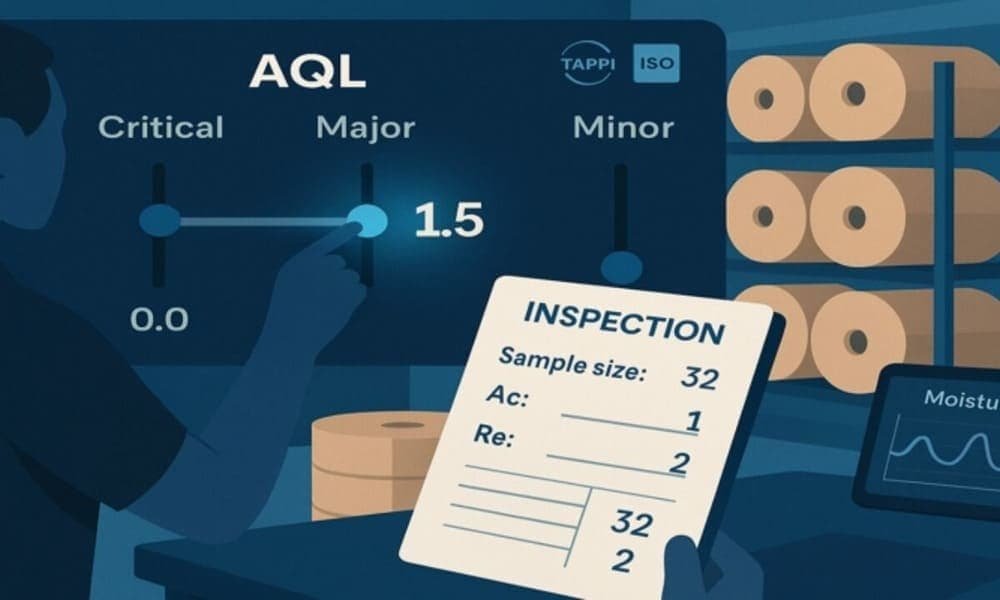
GI, GII, and GIII are sampling intensity choices in ISO 2859-1 / ANSI Z1.4. They map to code letters that determine sample sizes.
GII is the industry default for routine consumer goods; GIII increases sample size for higher detection power; GI is lighter and cheaper but may miss systemic issues.
The table below shows typical single-sampling, normal plans for common lot sizes. Values align with reputable calculators and tables.
| Lot size | GI (code→n) | GII (code→n) | GIII (code→n) |
|---|---|---|---|
| 500 | H → 50 | J → 80 | K → 125 |
| 2,000 | J → 80 | K → 125 | L → 200 |
| 5,000 | K → 125 | L → 200 | M → 315 |
Short recap: moving from GI → GII → GIII increases n (sample size), raises inspection time and cost, and improves your chances of catching defect patterns before shipment.
Risk strategies compared—Conservative vs Balanced vs Lean
Think of three playbooks and choose the one that matches your situation. Balanced is the default. Tighten to Conservative for high risk or new suppliers. Relax to Lean for mature, low-risk SKUs with a strong quality history.
| Strategy | Typical use-case | Level | Recommended AQLs (Critical/Major/Minor) | Example lot 2,000 (n / Ac/Re) |
|---|---|---|---|---|
| Conservative | New supplier; high-risk SKU; recent failures | GIII | 0 / 1.0–2.5 / 2.5 | 200 → Critical 0→0/1; Major 1.0→5/6; Major 2.5→10/11; Minor 4.0→14/15 |
| Balanced (default) | Routine orders; stable supplier | GII | 0 / 2.5 / 4.0 | 125 → Critical 0→0/1; Major 2.5→7/8; Minor 4.0→10/11 |
| Lean | Trusted supplier; low-risk items | GI | 0 / 2.5 / 4.0 (minor may be 4.0) | 80 → Critical 0→0/1; Major 2.5→5/6; Minor 4.0→7/8 |
The example Ac/Re values reflect ISO 2859-1 / ANSI Z1.4 single-sampling, normal plans commonly published by reputable QC firms and calculators.
At n=125, AQL 2.5 typically yields Ac/Re of 7/8;
at n=200, AQL 2.5 yields 10/11;
and AQL 0 consistently uses Ac=0/Re=1 across these n values.
Home & Kitchen scenarios—how to choose in practice

- Stainless steel tumblers (vacuum insulated): Start Balanced (GII; 0/2.5/4.0). Put functional checks front and center: leak test, lid fit/seal, vacuum integrity, dishwasher cycles, odor. If the first order shows seal or vacuum failures, move to Conservative (GIII; Major 1.0) for the next 1–2 lots. For material-safety and migration testing, use appropriate lab protocols beyond AQL sampling.
- Ceramic tableware: Cosmetic minor defects (glaze pinholes, decoration misalignment) are common. For new suppliers—or when food-contact claims are prominent—run Conservative early (GIII; keep Critical=0, consider Major 1.0 for crack/warp). Once stable, return to Balanced. Laboratory lead/cadmium migration tests under ISO 6486 remain essential and sit outside AQL inspection.
- Silicone utensils: Surface finish and cure quality matter (no greasy residue, no strong odor). Balanced is fine for mature suppliers, but if you see cure issues or recurrent odor complaints, switch to GIII for a few lots and keep Minor at 4.0 only if cosmetic blemishes don’t affect function. Handle migration/specific migration via accredited lab testing.
- Storage boxes and kitchen tool sets: Parts counts and assembly fit stack up risks. Balanced usually works. If mixed materials and many SKUs are packed together (inserts, labels, bags), you may hit time pressure—either book extra man-days or step to GIII for the first deliveries to catch kitting errors. When stability is proven across 3–5 lots, consider Lean for reorder waves provided returns are minimal.
Tip: Think of AQL like a spotlight. GI is a desk lamp, GII a bright work light, and GIII a floodlight. Use the floodlight when you’re still learning the terrain.
Upgrade/downgrade mechanism that aligns with ISO 2859-1

Start at Balanced (GII; 0/2.5/4.0). Tighten or relax based on performance—and document it in your PO and quality plan so inspectors and factories follow the same playbook.
- Tighten triggers: If you record two rejections within five lots under normal severity, switch to tightened severity per ISO 2859-1 clause 9.3, and consider raising the inspection level to GIII and/or lowering AQLs (e.g., Major from 2.5 to 1.0) until stability returns. After five consecutive accepted lots under tightened, revert to normal.
- Reduced/Lean conditions: Only use reduced severity when production is steady, the switching score meets the ISO threshold, and the responsible authority approves—otherwise stay at normal severity.
- Communication: Specify “Single sampling, normal; General Level II; AQLs 0/2.5/4.0” (or your chosen plan) in the PO and inspection booking. If you’re stepping up to GIII or changing AQLs, state the rationale and duration (e.g., “Apply GIII + Major 1.0 for next two lots due to first-order failures”).
Packaging and handling add-ons (ISTA basics)
AQL focuses on unit quality. Transit damage is a different risk bucket. For e-commerce and parcel networks, consider running packaging performance tests:
- ISTA 3A for general small-parcel shipments up to 150 lb—random vibration, drop, and compression sequences.
- Amazon ISTA 6 for Amazon-bound goods, with SIOC/OB variants tailored to Amazon’s network data.
Authoritative summaries of these programs are available from labs and the ISTA directory.
Also consider
If you’d prefer a managed approach that combines supplier coordination, booking inspections, and logistics, a one-stop sourcing partner can help ensure the plan you choose is applied consistently.
Yansourcing coordinates sourcing, inspections, and shipping in China for brands of different sizes.
Disclosure: Yansourcing is our product.
Learn more at Yansourcing.
Bottom line: Start Balanced (GII; 0/2.5/4.0), then let results move you.
Define defect classes clearly, pick the inspection level that matches the risk, and write these choices into your PO and QC checklist so every factory and inspector is on the same page.
When in doubt, tighten temporarily and review the data after a few lots—then relax once the numbers back you up.
