

High return rates bleed margins in furniture and upholstery: freight both ways, rework, write-offs, and the long tail of bad reviews.
Most of those returns trace back to three root causes—structural instability, finish defects, and transit damage.
The fix isn’t magic; it’s a disciplined program you can run in Chinese factories:
a phased workflow, clear CTQs (critical-to-quality), AQL-based sampling, 100% checks on safety-critical items, and packaging validated against realistic shipping abuse.
This guide shows exactly how to do it.
A US/EU/UK compliance quick-reference sits in the appendix so the main flow stays practical.
Phase 1 — Pre-production: Set the foundation

Lock the basics before a single frame is assembled. Think of this phase as your insurance policy: it’s cheaper to prevent than to rework.
- Specification & Golden Sample Build a complete spec pack: materials (composite wood, foam, textiles, finishes), structural drawings with tolerances, hardware callouts, surface finish schedule, labeling/marking plan, and packaging drawings. Approve a Golden Sample that’s photographed from all angles with CTQs annotated (joint type and fastener length, seam allowance and stitch density, finish tone/gloss, drawer clearances). Store the Golden Sample properly and serialize it.
- Compliance scoping by destination markets For the United States, confirm composite wood compliance under TSCA Title VI (labeling, records, and recognized third-party certifiers) per the EPA’s formaldehyde pages: see the laws and program overview in the EPA’s formaldehyde regulations portal. If you work with CARB suppliers, align interpretations with the CARB vs. EPA comparison table (Jan 2024). For upholstered seating sold in the US market, plan smolder resistance per California’s TB117-2013 test method access. For the EU, plan for formaldehyde “emission into indoor air” limits in REACH Annex XVII Entry 77 as adopted by Commission Regulation (EU) 2023/1464 and maintain GPSR-compliant technical documentation. For UK sales, follow the Furniture and Furnishings (Fire) (Safety) regime as amended in 2025 per GOV.UK guidance on the 2025 amendment.
- Lab and document plan (risk-based) Formaldehyde/emissions: collect TSCA Title VI documentation from panel suppliers (TPC and lot references) for US, and schedule chamber tests to evidence REACH Entry 77 for EU placements on or after the applicable date. Flammability: plan TB117-2013 smolder tests for US upholstery; for EU/UK projects specify EN 1021-1/-2 when required by buyers or tenders (UK legal compliance is governed by UK law; EN tests may be used for performance benchmarking). Durability/stability: for domestic seating into the EU, many buyers reference EN 12520 with test methods from EN 1728 (strength/durability) and EN 1022 (stability); confirm current status via the BS EN 12520:2024 listing.
- Packaging DFM and test selection Choose an ISTA profile based on channel. For parcel/e-commerce cartons, ISTA 3A is a common baseline; for LTL or palletized unit loads, ISTA 2B/3B-style programs are typical. Review drop orientations (faces, edges, corners), random vibration, and compression. ISTA offers public overviews and equipment guidance—start with the ISTA required equipment and procedures overview to align with labs.
- Sampling plan and defect policy The industry default for pre-shipment inspection (PSI) is ISO 2859-1 (or ANSI/ASQ Z1.4) at General Inspection Level II. Set AQLs at Critical 0.0, Major 2.5, Minor 4.0 unless your risk profile demands tighter thresholds. Define a defect classification matrix with examples relevant to furniture: missing anti-tip restraint or a sharp edge = Critical; visible finish scratch on a primary zone or wobble beyond spec = Major; small color variation in a concealed area = Minor. For safety/regulatory CTQs (anti-tip hardware presence, warning labels, sharp edges, anchor screws), plan 100% checks at PSI.
Checklist — Pre-production (owner → deliverable)
- Buyer/QA → Approved spec pack and Golden Sample with annotated CTQs and photos.
- Factory → TSCA Title VI panel documents for US; preliminary plan for EU REACH Entry 77 evidence; flammability test bookings.
- Buyer/QA → Packaging drawings with chosen ISTA profile and pilot plan.
- Buyer/Factory → AQL plan (Level II; 0.0/2.5/4.0) and written defect classification matrix with go/no-go examples.
Phase 2 — During production: Control the CTQs
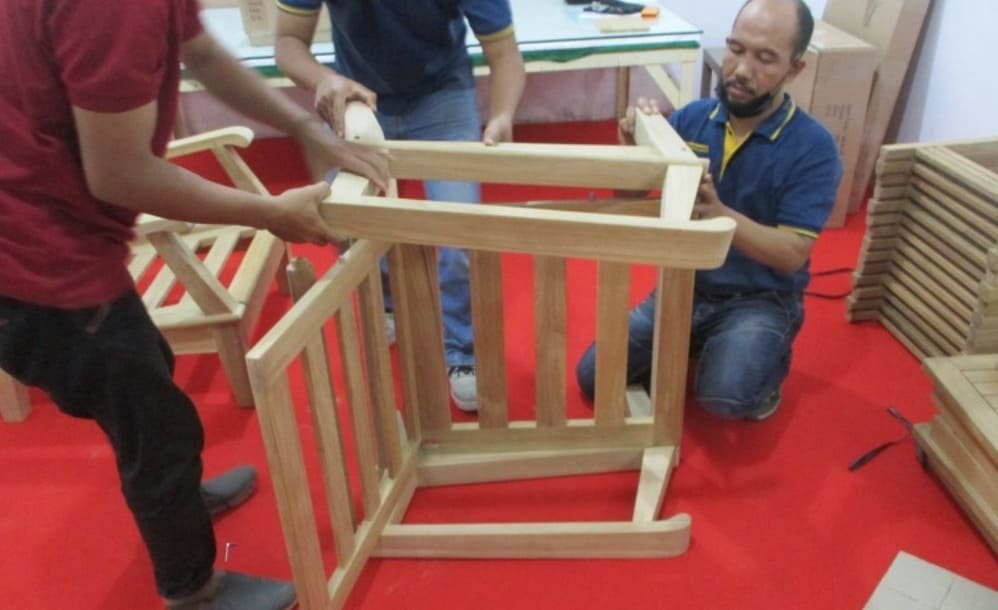
This is where latent defects sneak in. Small misses at glue-up or upholstery can snowball into wobble, seam failure, or finish print-through after shipping.
- Incoming QC and in-line checks Panels: verify TSCA Title VI identifiers on incoming lots and keep traceability. For EU-bound runs, align an emissions testing schedule to avoid end-stage surprises. Textiles/foams: check recent supplier test certs—abrasion (ISO 12947/ASTM D4966), colorfastness (ISO 105/AATCC), seam slippage (ISO 13936-2), foam density and IFD (ASTM D3574). Hardware: confirm torque settings and corrosion protection if specified.
- Workstations and critical stations Frames & joints: verify joinery type matches the Golden Sample; monitor glue spread, clamp pressure, and cure times; pilot wobble checks on first-off assemblies. Upholstery: control seam allowance and stitch density; check alignment and tension to avoid wrinkles or seam grinning; probe seam slippage with quick in-line pulls. Finishes: watch film build, flash-off, and cure windows; do quick adhesion probes (cross-hatch or pull tape) on sacrificial panels.
- Interim packaging pilots Fit test the inserts and corner protection at the line. If lab slots are not immediately available, do a reduced-profile pilot: a few orientation drops at reduced heights and a short random vibration exposure to surface obvious weaknesses. Update packaging drawings.
- Corrective action loop Set triggers: if projected Major defects exceed 2.5% in a sub-lot, stop, contain, and adjust process parameters. Re-verify against the Golden Sample. Document with photos and short videos to build your CAP record.
Checklist — During production (owner → deliverable)
- Factory QA → Incoming materials verification records (panels, fabrics/foams, hardware).
- Line leader/QA → WIP CTQ check logs (joints, seams, finishes) with first-off sign-off.
- Packaging engineer/QA → Pilot results and updated packaging drawings.
- Buyer/Agent → CAP issued and verified closure when trend triggers fire.
Phase 3 — Pre-shipment: Verify and validate (furniture quality control China)

Now prove the lot conforms—functionally, cosmetically, and for transit.
- Apply AQL sampling (Level II) Use ISO 2859-1 or ANSI/ASQ Z1.4 tables to select sample size. Recommended defaults remain Critical 0.0; Major 2.5; Minor 4.0. If you’re new to the system, the ISO 2859-1 catalog page describes the AQL-indexed framework.
- 100% checks for safety/regulatory CTQs Do not sample: verify anti-tip devices and anchors are present; warning and care labels are correct; sharp edges and burrs are absent; anchoring screws and wall straps match BOM; child-related exclusions (if any) are observed. For clothing storage units specifically, follow your buyer’s stability program and label requirements.
- Functional and stability checks Cycle drawers and doors (short cycles at PSI: e.g., 10–20 cycles as a spot check) and confirm smooth operation. Measure wobble/rock on a flat surface against your spec, and verify tilt/stability for chairs and storage according to your acceptance criteria.
- Finish/appearance and dimensions Use zone mapping: tightest criteria in primary view zones, relaxed criteria in secondary/hidden zones. Confirm color tone, gloss uniformity, scratch and dent thresholds, and veneer/edge alignment. Measure key dimensions and clearances.
- Documentation readiness Confirm TSCA Title VI labels for US-bound goods that incorporate regulated composite wood and that panel certificates are on file. For EU placements after the applicable date, maintain REACH Entry 77 emission test evidence and your GPSR-compliant technical file. For the UK, verify conformance and labeling under the amended FFRs.
- Packaging validation by route Parcel/dtc: run or reference an ISTA 3A report for representative SKUs; at minimum, verify carton strength and protective fit, then re-check after PSI handling. LTL/palletized: confirm unit-load integrity—stack compression, corner/edge protection, banding/film wrap specs. Document any lab reports and attach to the shipment file.
Checklist — Pre-shipment (owner → deliverable)
- Inspector → PSI report with AQL Level II results and defect breakdown.
- Inspector → 100% CTQ checklist for anti-tip, labels, sharp edges, anchors.
- QA → Functional/stability and finish/appearance measurements with photos.
- QA/Packaging → ISTA-aligned packaging sign-off and report references.
- Compliance lead → TSCA/REACH/UK FFRs documents and labels verified.
A practical workflow example

A mid-size importer selling a wood storage cabinet across the US, EU, and UK runs one integrated workflow.
A sourcing agent like Yansourcing coordinates panel documentation for TSCA Title VI with the board mill; books a domestic seating durability program for EU variants; sets the PSI to General Inspection Level II with AQLs at 0.0/2.5/4.0; and pilots packaging to an ISTA 3A profile for parcel shipments and a 2B-style profile for palletized retail.
Disclosure: Yansourcing is our product.
Troubleshooting and corrective actions
- Wobble or instability at PSI Likely causes: loose joints, under-cured adhesive, uneven feet, or machining variation. Actions: stop shipment for the lot; re-torque fasteners, re-glue and clamp per spec; add levelers; tighten machining tolerances; increase in-line wobble checks on first-offs.
- Finish defects (prints, orange peel, soft film) Likely causes: insufficient flash-off, incorrect mixing ratio, or contamination. Actions: adjust booth parameters; extend cure; improve filtration and tack-cloth routine; raise rework thresholds for primary zones; verify adhesion with quick probes before restart.
- Upholstery seam failure or grinning Likely causes: low seam allowance, low stitch density, fabric weave/slippage risk. Actions: increase allowance or SPI; add seam tapes for risky weaves; re-train operators with Golden Sample as visual standard.
- Transit damage spikes Likely causes: insufficient corner protection, weak carton, voids in pack, or route shifts to rougher handling. Actions: add molded corner blocks, increase board grade/ECT, fill voids and immobilize hardware, and re-validate with targeted drops and vibration aligned to the actual channel.
- Documentation gaps discovered late Actions: hold shipment; obtain missing TPC/TSCA references; align EU REACH Entry 77 emissions evidence for EU placements on or after the applicable date; verify UK FFRs labels.
Appendix — US/EU/UK compliance quick reference

The table below maps frequent requirements buyers ask factories to meet. Always confirm the latest legal texts and retailer specifications before production.
| Topic | United States | European Union | United Kingdom |
|---|---|---|---|
| Formaldehyde in composite wood/panels | TSCA Title VI emission standards; labeling and TPC certification per EPA’s program. See the EPA formaldehyde regulations portal and CARB alignment comparison (Jan 2024). | REACH Annex XVII Entry 77 sets emission limits for wood-based panels and furniture placed on the EU market; see Regulation (EU) 2023/1464. | UK REACH applies to chemicals in articles; formaldehyde duties may arise via restrictions and general product safety. Align with UK guidance and keep test evidence where requested. |
| Upholstered seating flammability | Smolder resistance per California TB117-2013 access page, widely adopted as a US market expectation. | EN 1021-1/-2 often specified by buyers for performance; legal obligations come via GPSR and national requirements. Confirm retailer specs. | Furniture and Furnishings (Fire) (Safety) Regulations 1988 as amended in 2025; follow GOV.UK 2025 amendment guidance for scope, testing, and labeling. |
| Seating strength/stability benchmarks | Buyers may specify ASTM/BIFMA methods; for clothing storage units, follow buyer programs referencing stability and anti-tip hardware. | Domestic seating commonly references EN 12520 with EN 1728 (strength/durability) and EN 1022 (stability). Verify current issue; see BS EN 12520:2024 listing. | Buyers may reference BS/EN equivalents similar to the EU. Confirm with UK retailers and current BSI listings. |
| Packaging validation | Retailers and e-commerce often require ISTA testing; choose profile by route (3A for parcel; 2B/3B for palletized). See ISTA procedure/equipment overview. | Same as US; ISTA profiles widely used by European retailers and e-commerce. | Same as US/EU; confirm with UK channels and logistics partners. |
| AQL sampling for PSI | ISO 2859-1 or ANSI/ASQ Z1.4; Level II common; set AQLs at 0.0/2.5/4.0; 100% checks on safety/regulatory CTQs. See ISO 2859-1 catalog. | Same approach applies; align with retailer QA manuals. | Same approach applies; align with retailer QA manuals. |
Notes:
- Distinguish mandatory legal requirements (e.g., TSCA Title VI; UK FFRs) from buyer-specified or voluntary standards (ASTM/BIFMA, EN seating).
- For EU placements after the applicable date in Entry 77, maintain emissions evidence in the technical file.
- Use test labs accredited for the relevant methods and markets; keep traceable documentation in your QA archive.
Summary and next steps
- Establish a rigorous pre-production baseline: complete specs, a Golden Sample, a lab/document plan, and an AQL/defect policy.
- Control CTQs during production with targeted station checks and interim packaging pilots.
- Verify lots at pre-shipment with AQL sampling, 100% checks on safety/regulatory CTQs, and transit-ready packaging validated against the real route.
If you adopt this three-phase workflow for furniture quality control in China, you’ll cut expensive returns from wobble, finish flaws, and shipping damage—and you’ll do it in a way that scales across US/EU/UK placements.
Keep the appendix handy as you assign tasks and book labs.
And if your channel or retailer adds extra requirements, fold them into the same structure so your team always knows what to do, when, and how to prove it.
