

If you manage multiple suppliers in China, this guide gives you a copy-ready Quarterly Business Review with Chinese factories that turns explanations into corrective results—targeting OTD ≥95%, 100% CAPA closure with Owner + Due date + Verification method, and a living Top 3 risk register with contingency plans.
Prepare the QBR data pack

Your QBR succeeds or fails on the inputs. Freeze last quarter’s QBR data pack 3–5 business days after quarter close and share a bilingual pre-read at least 2 business days before the meeting.
Core KPIs and plain-English formulas
- On-Time Delivery (OTD): percentage of deliveries that arrive within the agreed window. OTD % = on-time deliveries ÷ total deliveries × 100. For accepted definitions and window rules, see MetricHQ: On-time delivery overview and TL 9000’s examples: OTI rule set (PDF).
- On-Time In-Full (OTIF): delivered on time and at full quantity. OTIF % = (orders or lines that are both on time and in full) ÷ total due × 100. See a manufacturing-focused overview from MRPeasy.
- First Pass Yield (FPY): percent that pass specs the first time, no rework. FPY % = good units ÷ total units × 100. Background and calculation: SixSigma.us FPY.
- Parts Per Million (PPM): defective parts per million delivered/inspected. PPM = defective units ÷ total units × 1,000,000. Primer: Six Sigma Daily on PPM vs DPMO.
Measurement windows and exclusions (document these in your deck)
- Window: choose exact date, on-or-before, or tolerance (e.g., −0/+2 days). Early deliveries may be counted as late unless agreed; align with your logistics policy. TL 9000 provides examples.
- Exclusions: customer-requested reschedules, cancellations, force majeure. Separate carrier-caused delays; don’t commingle with supplier OTD.
What to include in the pre-read
- KPI summary: last quarter vs target, plus 4–8 quarter trends for OTD, OTIF, FPY, and PPM.
- Incident digest: top quality and delivery incidents with impact (late days, scrap/cost, customer complaints), linked to CAPAs.
- CAPA inventory: all open/closed actions with Owner, Due date, Verification method, and Evidence link.
- Shipment and inspection summary: late/partial shipments, premium freight use, incoming/final inspection results.
- Attendance matrix: confirm who’s joining from factory (GM/plant manager, QA lead, planning) and buyer side.
Copy-ready pre-QBR checklist (paste into Sheets)
| Item | Description | Owner | Due date | Status |
|---|---|---|---|---|
| Data freeze | Freeze KPI and incident data 3–5 business days post quarter | Buyer Ops | ||
| Definitions page | Add KPI definitions, windows, and exclusions to appendix (bilingual) | Buyer SQE | ||
| Trends | Insert 4–8 quarter trend charts for OTD, OTIF, FPY, PPM | Analyst | ||
| Incident digest | Top incidents with impact and links to CAPAs | Buyer SQE | ||
| CAPA inventory | Export CAPA list with Owner/Due/Verification/Evidence | Supplier QA | ||
| Inspection summary | IQC/FQC results and sampling plans used | Buyer Quality | ||
| Attendance | Confirm factory GM/QA lead/planner attendance | Supplier Sales | ||
| Pre-read send | Share deck to factory 2 business days before QBR | Facilitator |
Run the Quarterly Business Review with Chinese factories step by step

Recommended duration: 90–120 minutes. Keep slides bilingual for key pages. Use WeChat for day-to-day follow-ups, but confirm all commitments by email for records. Ready to run?
Agenda and scripts
- Objectives and tone (5–10 min)
- Script: “Thank you for joining. Today we’ll confirm last quarter’s results, agree on corrective actions with owner, due date, and verification, and set next-quarter targets. The aim is OTD ≥95% and 100% CAPA closure with verified effectiveness.”
- KPI snapshot (15–20 min)
- Script: “Let’s align on definitions. Our OTD window is −0/+2 days; buyer-requested reschedules are excluded. Here’s the 6-quarter trend for OTD/OTIF/FPY/PPM.”
- Cultural tip: Ask the QA lead to present first, then invite GM commentary—this saves face while keeping technical facts upfront.
- Root-cause deep-dive (30 min)
- Method: 5-Whys or fishbone tied to your SCAR/8D form.
- Script: “Please walk us through root cause, containment, and long-term fix for Incident A. What evidence shows the true cause, and what changed in the process or control plan?”
- CAPA review and commitments (20 min)
- Rule: No action is “closed” without Owner + Due date + Verification method + Evidence link.
- Script: “For Action 12, who is the owner, what’s the due date, and how will we verify? For example, ‘c=0 incoming sampling across three consecutive lots’ or ‘FPY trend ≥98% for two months.’”
- Risk register and contingency (10–15 min)
- Script: “Let’s capture Top 3 risks for next quarter—quality, delivery, or materials/compliance—and agree triggers and contingency plans.”
- Decisions and next-quarter targets (10–15 min)
- Script: “We confirm: OTD target ≥95% with −0/+2 window, FPY +3pp vs baseline, and PPM ≤100 for critical parts. We also confirm owners, due dates, verification plans, and the date for the post-QBR action log.”
- Close and follow-ups (5–10 min)
- Script: “We’ll share the numbered action log within 3 business days. We’ll track high-risk items monthly. Please send any additional evidence by Friday.”
Agenda structure inspiration: Gainsight on QBRs.
Make CAPA execution verifiable
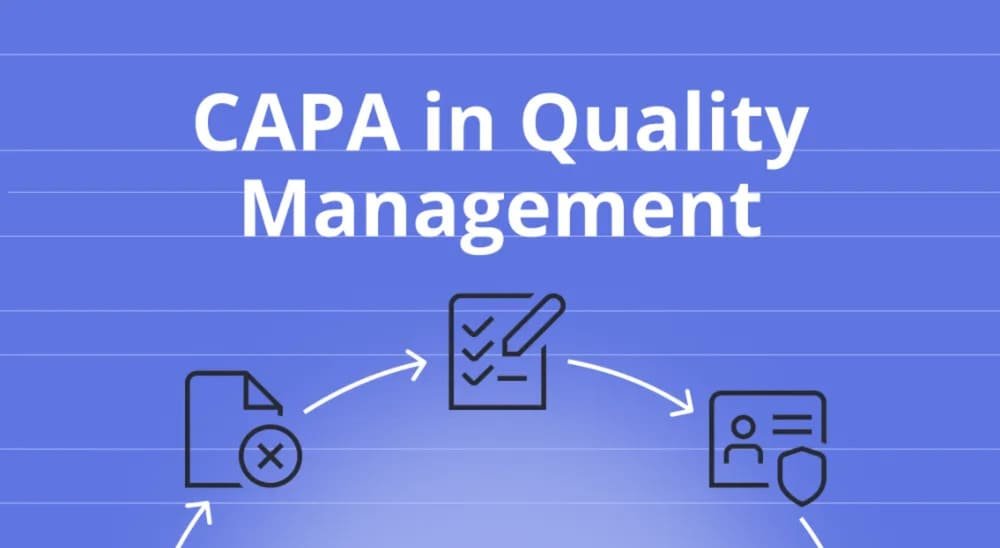
Treat CAPA/SCAR as an auditable loop. FDA guidance emphasizes verifying effectiveness and documenting outcomes before closure.
Closure standard
- No CAPA is closed until it has: Owner, Due date, Verification method, Evidence link, and a documented effectiveness review. See FDA CAPA inspection guide.
Accepted verification methods (choose per risk)
- Sampling plans: ANSI/ASQ Z1.4 or ISO 2859-1; consider c=0 for critical defects; verify across 3–5 consecutive lots. Helpful overview: STAT-12 on verification sampling.
- Trend windows: SPC charts or month-over-month KPIs; require sustained improvement (e.g., FPY ≥ target for 2 months; PPM ≤ threshold for a rolling quarter).
- Evidence package: updated SOPs, training records, control plan revisions, inspection records meeting the sampling plan, and—if needed—witnessed trial production or on-site audit.
- Change validation: trigger FAI/PPAP for new or significantly changed parts; see Capvidia’s PPAP guide and L3Harris FAI requirements.
Copy-ready CAPA/action log
| ID | Issue | Owner | Due date | Verification method | Evidence link | Status |
|---|---|---|---|---|---|---|
| 0012 | High PPM on gasket lot 23–27 | Supplier QA | 2026-02-15 | c=0 IQC across next 3 lots; PPM ≤100 rolling 3 mo | URL | Open |
| 0013 | Late deliveries on PO 1183, 1187 | Supplier Planner | 2026-01-30 | OTD ≥95% for Jan–Mar within −0/+2 window | URL | Open |
| 0014 | Low FPY at press line 2 | Process Eng. | 2026-03-05 | FPY ≥98% for 2 consecutive months; updated SOP + training | URL | In progress |
Keep a living risk register
Capture forward-looking risks and bind them to concrete triggers and contingency plans.
Top 3 risks template
| Rank | Risk description | Category | Trigger threshold | Contingency plan | Owner | Due date |
|---|---|---|---|---|---|---|
| 1 | Copper price spike impacts coil supplier | Materials | LME +15% within 30 days | Activate alternate spec; release 30-day buffer PO | Buyer | 2026-02-10 |
| 2 | New operator turnover on night shift | Quality | FPY <96% for 2 weeks | Add trainer coverage; raise sampling to c=0 | Supplier QA | 2026-01-25 |
| 3 | Port congestion at Yantian | Delivery | Transit >+5 days vs norm | Pull-in ex-works by 1 week; pre-book space | Logistics | 2026-01-20 |
Review these at every Quarterly Business Review with Chinese factories, and update contingencies if triggers are hit.
Governance cadence and escalation

Cadence
- Quarterly QBR held 3–4 weeks after quarter close, with monthly check-ins for high-risk items.
- Tier expectations: Tier-1 critical suppliers target OTD ≥95–98%; Tier-2 ≥90–95%.
Escalation ladder
- Level 1: operational—weekly check-ins, added inspection.
- Level 2: management—controlled shipping/100% inspection and on-site audit.
- Level 3: executive—probation or reallocation of volume.
Agent-supported workflow (optional)
- When you lack a local team, an external China sourcing agent can help compile KPI data, coordinate bilingual pre-reads, and verify CAPA evidence on-site between QBRs. For example, Yansourcing can be engaged to schedule factory attendance, consolidate scorecards, and witness trial runs, then provide photo/video evidence for verification. Disclosure: Yansourcing is our product.
Light version for resource-constrained teams
Need a rapid pass? Use this 45-minute QBR while keeping the non-negotiables (Owner + Due + Verification).
- 5 min: Objectives and expectations.
- 10 min: KPI snapshot (last quarter vs target); confirm definitions and windows.
- 15 min: Deep-dive the single biggest incident; agree root cause and long-term fix.
- 10 min: CAPA review—only top 5 actions; confirm verification methods and dates.
- 5 min: Risks and next steps; send action log within 2 business days.
Appendix: quick references
KPI definitions and primers
- OTD: MetricHQ’s overview of calculation and exclusions: On-time delivery.
- OTIF: manufacturing-focused explanation: MRPeasy OTIF guide.
- FPY: background and calculation: SixSigma.us FPY.
- PPM: difference vs DPMO: Six Sigma Daily primer.
CAPA and verification
- FDA perspective on effectiveness checks: FDA CAPA inspection guide.
- Sampling for verification: STAT-12 verification/validation sampling.
Agenda inspiration
- QBR agenda examples: Gainsight.
