
When you’re buying bathroom vanities and sanitary ware for 200, 500, or 1,000 rooms, “almost the same” isn’t good enough.
The moment finishes drift, dimensions miss rough-ins, or cartons arrive damaged, your install schedule slips and costs spike.
The playbook below is built for hotel OS&E and procurement managers who need one thing above all: consistency at scale.
What’s actually in scope—and where the risk hides

Hotel bathroom packages usually blend OS&E with edge-of-FF&E items. Expect these categories:
- Vanities/casegoods with stone or engineered tops
- Basins, toilets, and related sanitary ceramics
- Faucets, shower systems, and accessories
Risk concentrates where batches meet reality: color differences in stone and cabinet finishes, glaze shifts across ceramic kilns, dimensional tolerances that don’t match MEP drawings, and packaging that can’t survive a long ocean leg. Think of each as a control point you’ll lock down from mock-up through mass production.
Step 1 — Build a factory-ready BOQ/spec pack
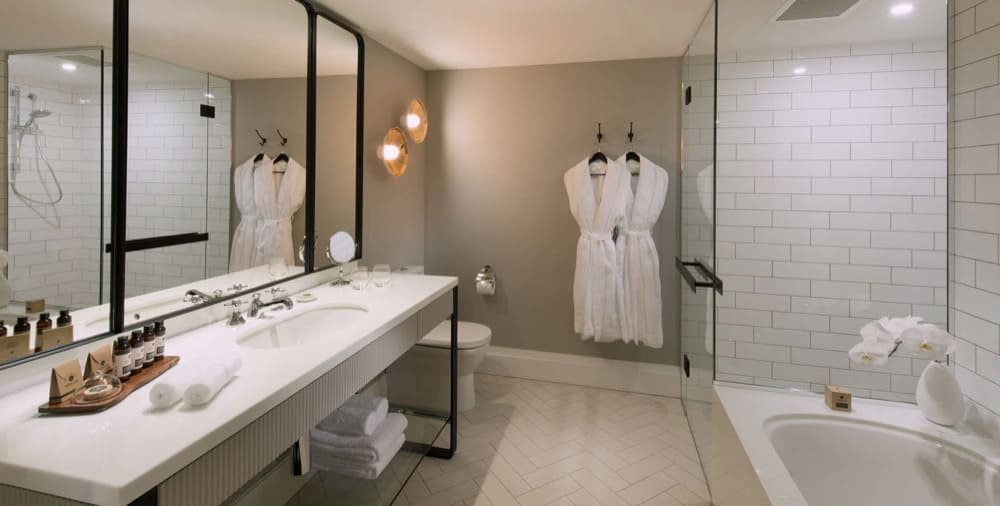
Give suppliers everything they need to quote precisely and manufacture repeatably. Your intake packet should include:
- A packaging and labeling brief: ISTA-like performance goals, carton specs, palletization rules, room-by-room master labels.
- Drawings and constraints: plan/elevation/sections, plumbing rough-in, faucet hole patterns, sink cutouts, mounting details, carrier specs.
- A finish schedule: cabinet finish, hardware finish, stone species/vein direction, faucet/shower trim finishes → with defined color targets and signed swatches.
- A compliance matrix: by market.
- A QC/AQL plan: inspection stages, sampling levels, defect classifications and limits, golden samples and retention sets.
For compliance mapping, anchor your asks to authorities:
- ADA (U.S. Department of Justice 2010 Standards)
- lavatories — Section 606
- toilets — Section 604
- showers — Section 608
- grab bars — Section 609
- Water-efficiency requirements
- U.S. EPA’s WaterSense program
- Hotel guidance from the H2Otel Challenge
- Plumbing-code conformance
- 2024 Uniform Plumbing Code overview
- ICC’s IPC 2024 access gateway
- Product standards
- ASME A112.19.2 / CSA B45.1 for ceramic fixtures
- ASME A112.18.1 / CSA B125.1 for plumbing supply fittings
- Drinking-water contact safety
- NSF/ANSI/CAN 61 and 372
- Composite wood emissions
- EPA’s TSCA Title VI composite wood program
- EU/UK requirements
- EU Drinking Water Directive (2020/2184)
- UKCA marking guidance
- National approvals as required (WRAS / DVGW / KIWA / ACS)
Step 2 — Vet suppliers by category with capability checks that matter
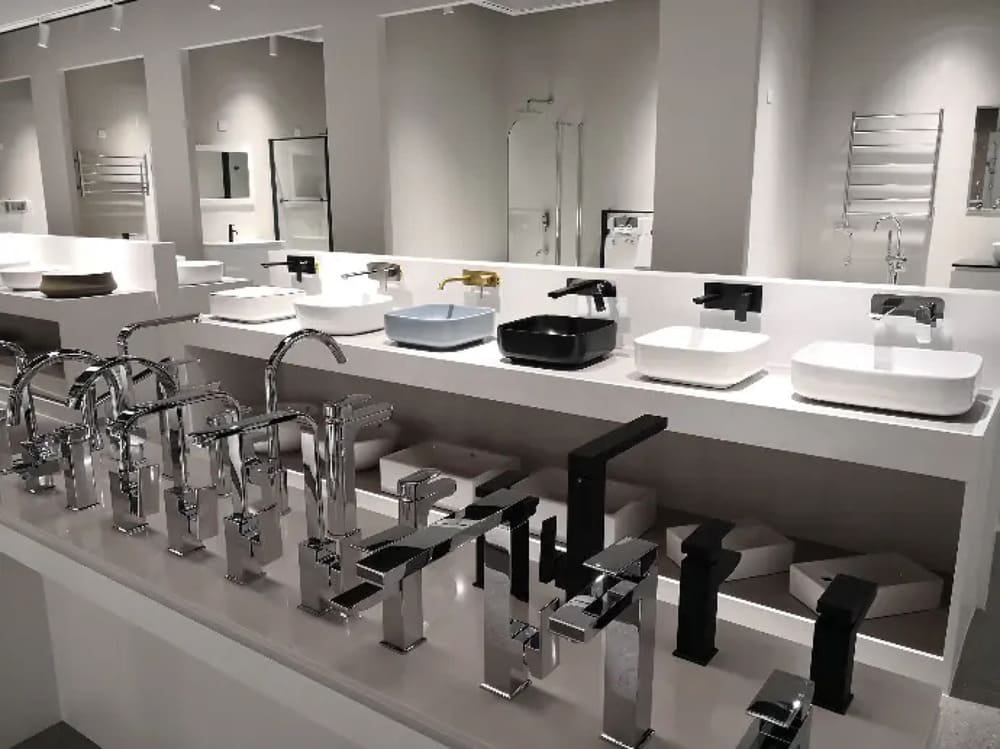
You’ll likely work with multiple factories. Focus on capabilities tied to consistency:
- Sanitary ceramics: kiln size and throughput; glaze application controls; warpage/flatness records; fixture testing capability (e.g., flush performance where relevant); previous hotel references.
- Vanities and stone: moisture-resistant substrates (MR MDF/ply); edge sealing; finish lines and color management; CNC and edge polishing for tops; vein-matching process for stone; hardware sourcing and corrosion resistance.
- Faucets and showers: in-house pressure/leak testing; finish adhesion/abrasion testing; documentation for lead-free and NSF 61/372; ability to supply WaterSense-labeled models when specified.
Ask for recent test reports, photos of in-process quality checkpoints, and capacity calendars. If they can’t show how they manage batch color or dimensional control, believe what they’re showing you.
Step 3 — Mock-up to golden sample: lock color and fit before you scale
The mock-up room is where you eliminate surprises. Set acceptance criteria and document them:
- Approve golden samples for each finish and component, then seal retention sets at the factory and with your team.
- Define color-difference targets (ΔE) for paints/laminates, and record stone selections and vein direction, with photos and logs.
- Check vanity dimensions against rough-ins and carriers, and verify sink cutouts, faucet hole spacing, and mounting hardware.
- For ceramics, inspect glaze coverage, flatness/warpage, and surface uniformity, and run functional checks where applicable.
Would you rather argue on site — or resolve it now, when changes are cheap?
Step 4 — QC for scale: AQL plans tailored to vanities and sanitary ware
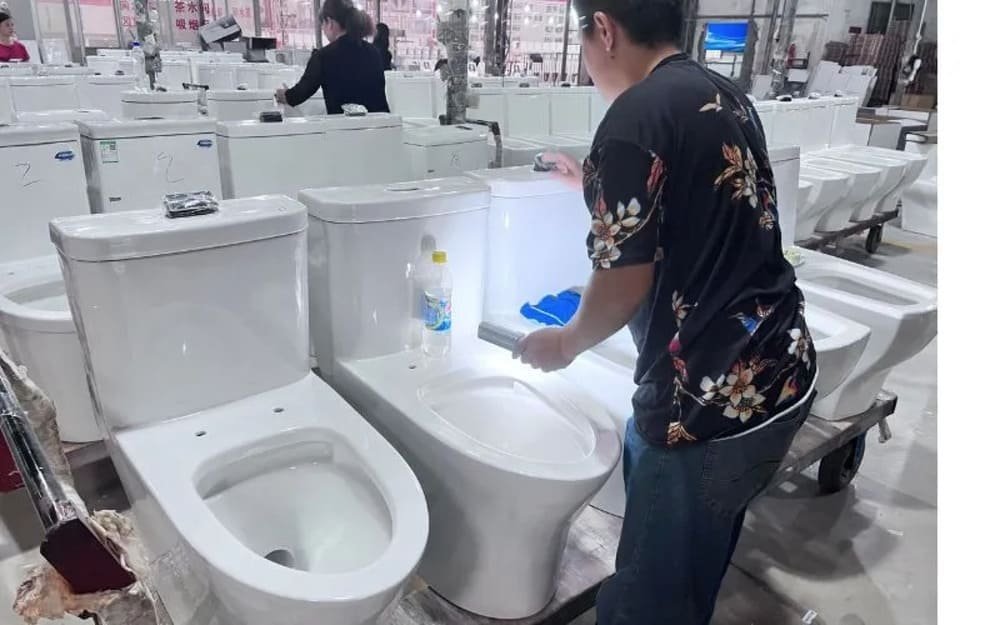
Use a staged inspection cadence grounded in ISO 2859-1 / ANSI/ASQ Z1.4 acceptance sampling.
Practical settings for hotel projects:
- General II for routine pre-shipment
- General III for first builds or critical items
- Special levels for small sub-lots
AQL targets embedded in POs and inspection plans:
- Critical: 0
- Major: 1.0–2.5
- Minor: 2.5–4.0
Robust in-process checks (DUPRO) include:
- For ceramics: glaze application, firing, machining
- For vanities: finish application, edge sealing
- For fittings: pressure / leak tests
Pre-shipment inspections use random sampling by attributes to verify:
- Dimensions
- Surface finishes against golden samples
- Functional tests (e.g., faucet flow / pressure)
- Packaging integrity
Keep photo records and lot traceability throughout. If you’ve ever felt a “mystery batch” slip through, this is how you stop it.
Step 5 — Packaging and labeling that survive the ocean—and speed installation
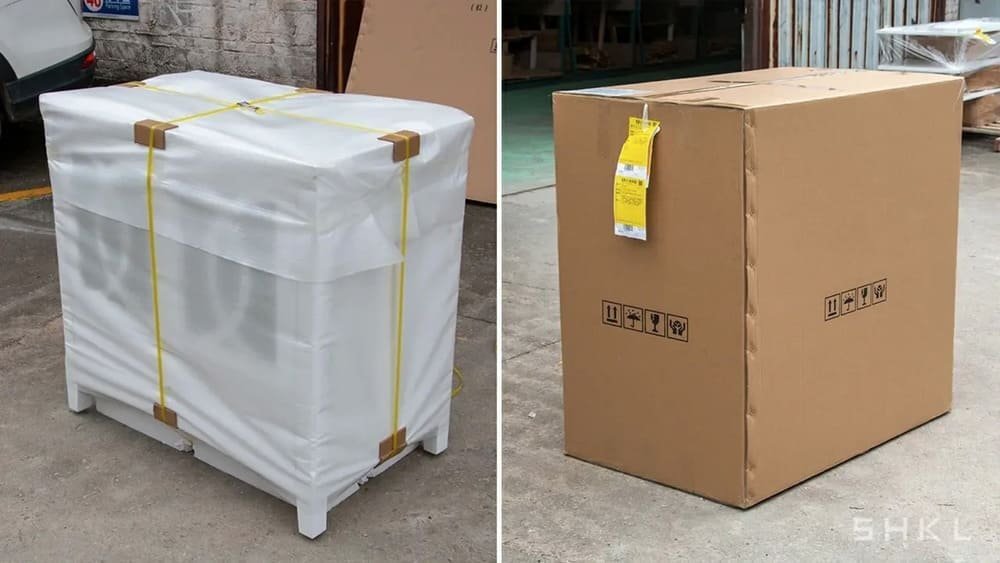
Transit damage and on-site chaos are preventable with engineered packaging.
Use double or triple-wall corrugate with adequate ECT/burst strength; maintain at least 1 inch internal clearance with foam or molded pulp, and reinforce corners and edges.
For stone and ceramics, add:
- Corner protectors
- Rigid frames or crating for heavy tops
- Individual foam shells for sinks and toilets
Palletize on ISPM 15-compliant pallets with no overhang; add corner boards, straps, and moisture barriers. Consider desiccants and humidity indicators for long transits.
Label master cartons with:
- Project
- Building
- Floor
- Room number
- Component list
Apply “This Side Up,” “Fragile,” tilt/shock indicators where justified. Prepare room-by-room manifests to mirror the installation sequence.
Validate your design using ISTA-like protocols (e.g., 3A for parcels, 3B for pallets) through a qualified lab or a comparable test plan.
A useful planning reference is URBN’s publicly available Furniture Package Test Requirements, which cites common ISTA methods.
Step 6 — Consolidation and timeline planning across multiple factories
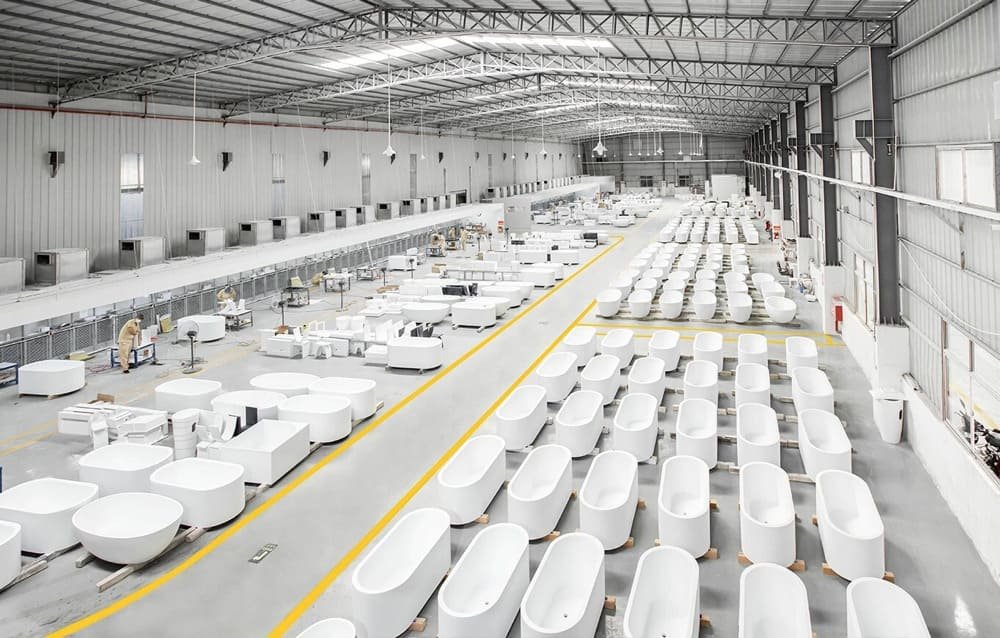
Map a schedule you can track. Typical ranges (adjust per project):
- Week 0–2: BOQ/spec intake; compliance matrix; supplier shortlist; shop drawings; mock-up approval.
- Week 3–8: Parallel production. Vanities/cabinets 30–45 days (60–90 for complex/custom), stone tops 20–35, ceramics 25–40, faucets/shower sets 15–30. The bottleneck is often cabinetry and stone.
- Week 8–10: DUPRO/PSI; rework buffer; finalize room-by-room packing lists.
- Week 10–12: Consolidation at a hub (Foshan/Guangzhou/Ningbo/Shanghai); staging 5–10 days; photo-documented container loading.
- Ocean legs (indicative): China→US West 15–25 days; US East 30–35; North Europe 35–45; UK 30–40. Add port dwell and drayage buffers.
Define a claims protocol and insure for full replacement cost. Require loading photos and keep a shared tracker for lot numbers, cartons, and room labels.
Practical workflow example (first mention disclosure)

Disclosure: Yansourcing is our product.
In a 420-room coastal hotel, three factories were coordinated: faucets/showers, sanitary ceramics, and vanities with stone tops.
After the mock-up sign-off, we issued golden samples and ΔE targets for finishes. Each factory ran DUPRO, then a joint pre-shipment inspection was held at the consolidation hub.
Master cartons carried project, floor, and room numbers (e.g., “Tower A — 12F — Room 1216 — Vanity Set + Basin + Faucet”). Container loading was photo-documented, and shock/tilt indicators were applied to the stone crates.
Result: installers could stage by floor, lift the correct cartons, and complete rooms in sequence with near-zero rework.
That’s the power of consistency when every room must look and perform the same, day after day.
Compliance quick-reference: what to request from factories
Below is a concise mapping of regions to documents and standards you’ll typically request. Use this as a checklist and verify specifics with your design team and AHJ.
| Region/Scope | Key references | What to request |
|---|---|---|
| United States | DOJ 2010 ADA Standards; EPA WaterSense; 2024 UPC/IPC referencing ASME/CSA; NSF 61/372; EPA TSCA Title VI | ADA-compliant shop drawings; WaterSense certificates (toilets, faucets, showerheads) with accredited lab data; cUPC or equivalent listings; ASME A112.19.2/CSA B45.1 and A112.18.1/CSA B125.1 certificates; NSF/ANSI/CAN 61 and 372 certificates; TSCA Title VI for composite wood |
| European Union | EU Drinking Water Directive (2020/2184) and implementing hygiene rules | Materials migration/health test reports; positive list compliance; national marks where required (during transition) |
| United Kingdom | UKCA marking guidance; WRAS | UKCA/CE applicability confirmation; Declaration of Conformity; WRAS approvals for fittings in contact with drinking water |
For authoritative reading, see: the U.S. DOJ’s 2010 ADA Standards overview; the U.S. EPA’s WaterSense program and its H2Otel Challenge; IAPMO’s Uniform Plumbing Code page and the ICC’s IPC 2024 gateway; ASME’s pages for A112.19.2/CSA B45.1) and A112.18.1/CSA B125.1; NSF’s NSF/ANSI/CAN 61 overview; the EPA’s TSCA Title VI composite wood program; the EU’s Drinking Water Directive text; and the UK government’s UKCA marking guidance.
Next steps
Ready to reduce risk and keep your install on schedule?
Upload your BOQ/specs and we’ll return a consolidated quote with factory capacity notes, a compliance matrix, and a draft QC/packaging plan tailored to your project.
