

A 3–5 mm error in a shower panel or a vanity top can stall an entire floor.
Doors don’t close, clamps don’t align, and stone won’t clear a hallway turn—cue rework, missed handover, and claims.
If you’re importing vanities and glass from China, the fix isn’t guesswork; it’s a disciplined field-to-factory process built around:
- dual units
- explicit tolerances
- installability checks
This guide shows you how to:
- sign off shop drawings that install on the first try
- make mixed units foolproof
- capture site data that survives fabrication

1) Make mixed units foolproof
Mixed imperial↔metric teams are where most mistakes start. Here’s the protocol that stops them:
- Use the exact factor: 1 inch = 25.4 mm (ISO 80000-1 standard practice). Always show both units on critical dimensions.
- Set rounding rules: round to the nearest 1 mm for metric and 1/32 inch for imperial unless the fabricator confirms tighter resolution. Document these rules directly on the drawing.
- Label units on every dimension string; never rely on a single note. High-risk features—glass cut sizes, drilled holes, hinge offsets, plumbing centerlines—require dual dimensions plus tolerance callouts.
- Require a second-person conversion check for all shop drawings. A reviewer confirms that the inch value multiplied by 25.4 equals the millimeter callout, within the rounding policy.
- Sign off with roles: site lead verifies as-built, factory engineer confirms manufacturability, GC/project manager approves installability.
Think of dual-dimensioning as your “language interpreter” between field and factory. If the interpreter isn’t explicit, you’ll get a different story at installation.
2) Field measurements that survive fabrication
Capture what actually drives installability—not just “width × height.” On site, document:
- Openings: wall-to-wall widths at multiple heights, floor-to-ceiling where relevant; check plumb, level, and square. Note variance across the span.
- Transport path: stairs, door widths, turns, elevator cab depth. If a top fits the room but not the route, it still fails.
- Plumbing: drain and valve centerlines, rough-in heights, trap space, stud locations, and any blocking for vanity mounts.
- Clearances: front-of-vanity circulation, shower door swing, towel bar and cabinet conflicts. For planning norms, the NKBA’s updated bathroom guidelines (2023) outline commonly adopted clearances—see the NKBA design guideline overview (2023).
- Surface conditions: out-of-plane walls, uneven floors. Record actual deviations (e.g., 1/8 inch over 96 inches) so tolerances account for reality.
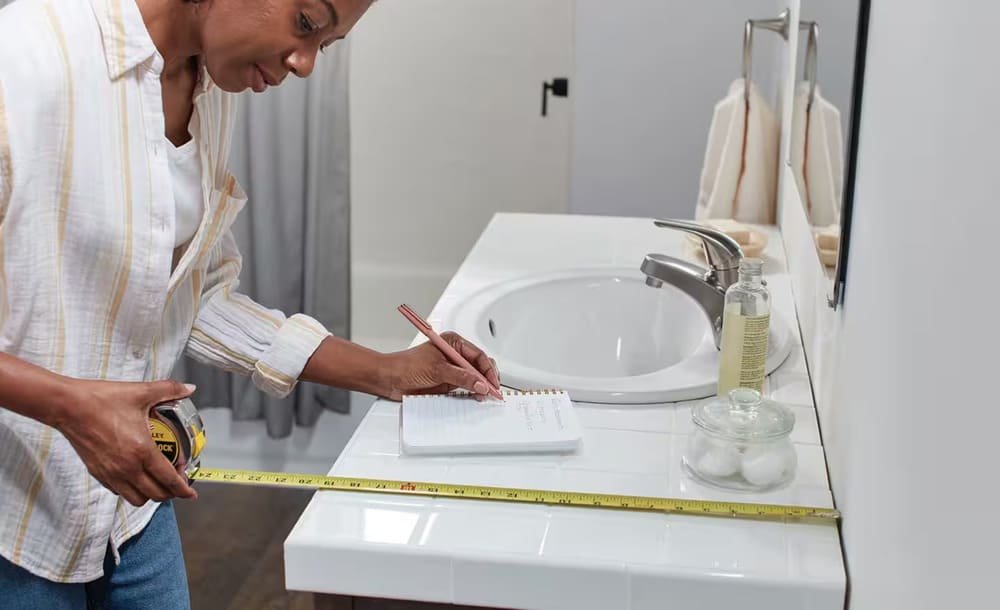
Summarize each opening with a simple sketch plus dual-unit dimensions and variance notes. Photos with a tape or laser measure in frame help the factory understand the “why” behind tolerances.
3) Shop drawings that install on the first try
Require factory shop drawings to display inches and millimeters on every critical callout. Add tolerances per component:
- Tempered glass panels: cut size tolerance, hole positions, edge offsets, hardware clearances.
- Stone vanity tops: slab thickness, sink/faucet cutouts, overhangs, and maximum unsupported spans.
- Cabinetry: case width/height/depth, squareness, mounting hole patterns.
Run an installability checklist before approval:
- Are all dimensions dual-labeled with units on the string (not just in notes)?
- Are rounding rules consistently applied (1 mm / 1/32 inch), and do inch↔mm values match under 25.4?
- Does the tolerance stack still leave clearance for install? Example: opening width minus panel width minus gasket/hinge offsets ≥ your minimum clearance target.
- Are plumbing cutouts aligned to as-built rough-ins? The International Plumbing Code (IPC) 2024 gives baseline fixture and rough-in requirements—cross-check locations and access.
- Do glazing specs meet mandatory safety standards? The IBC identifies shower enclosures as hazardous locations needing compliant safety glazing; see IBC 2024 Chapter 24: Glass and Glazing and federal safety glazing under CPSC 16 CFR 1201.
Hold a brief coordination meeting (GC, installer, factory engineer). Resolve discrepancies, record revisions, and get stamped approval before fabrication.
4) Typical tolerances and what they mean on site
Below are common, industry-standard practice ranges. Always verify your fabricator’s exact specs.
| Component | Typical fabrication tolerance | Practical site implication |
|---|---|---|
| Tempered glass panel cut size | +0 / −1/16 in (≈1.6 mm) | Leave clearance at jambs; avoid “zero gap” designs. |
| Glass drilled hole position | ±1/8 in (≈3 mm) | Choose hardware with tolerances; avoid tight-fit clamps. |
| Stone top thickness | ±1/32–1/8 in (±0.8–3.2 mm) | Shim for level; confirm sink/cabinet compatibility. |
| Stone rectangular dimension | ±1/16 in (≈1.6 mm) | Check door/turn path; don’t design to exact opening. |
| Cabinet squareness | ±1/16–1/8 in | Expect shimming; verify reveal consistency. |
For stone fabrication and installation practices, the Natural Stone Institute library curates specification resources.
5) Compliance checkpoints you can’t skip
Safety glazing marks need to be present and legible, indicating compliance such as CPSC Category II or ANSI Z97.1 class; cross-check against the approved shop drawings.
Validate plumbing rough-ins — valve and drain centerlines — against code and fixture templates prior to fabrication; the IPC/UPC baseline is your anchor, with local amendments as applicable.
For Australia/New Zealand, coordinate early for AS/NZS 2208 glazing and AS/NZS 3500 plumbing requirements if your project requires evidence of conformity.
Compliance is binary at inspection; build it into the drawing and QC workflow rather than treating it as a late check.
6) Practical example — how our verification prevents rework

Disclosure: ChinaBestBuy is our product.
Here’s a concise way to brief a Chinese factory on handrails and guards for a North America-bound project:
1) Code Requirements
- Handrail height 34–38 in per IBC §1014
- Guard height ≥42 in and openings per IBC §1015
- Structural loads per IBC §1607.8 / ASCE 7
- 50 plf uniform load
- 200 lb concentrated load
2) Slip & Glazing Requirements
- Request ANSI A326.3 wet slip test data for selected tread/nosing materials (with stair applicability caveat)
- Request safety glazing certificates to CPSC 16 CFR 1201 Category II for any glass guards
3) Technical Attachments to Send the Factory
- Dimensioned drawings
- Weld acceptance criteria (AWS D1.1 visual)
- Anchor ESR reports
- Packaging plan with edge protection and moisture control
This package gives factories clear targets and helps your team verify compliance.
7) QC milestones from factory to site
Where schedule allows, approve a first article—a single glass kit or a vanity with top—before full production.
Prior to shipment, verify critical dimensions against shop drawings, confirm safety glazing marks, and review edge quality and hardware packs in a documented inspection.
On arrival, re-measure panels and tops on site, re-confirm rough-ins, and photograph findings before installation; this record helps resolve any discrepancies quickly.
For scope and support, see Our Services.
8) What typically goes wrong (and how to correct fast)
- Glass off by 3–5 mm: Re-measure opening at multiple heights; if the miss is within gasket/hardware tolerance, re-locate clamps or swap gasket thickness. If not, order a rapid re-cut and stage other units to hold schedule.
- Drain misalignment: Use offset flanges or relocate the trap if deviation is minor; for larger shifts, adjust cutout on the top and re-center the sink, ensuring cabinet clearance.
- Stone top too large for door path: Cut in two pieces with a concealed seam, or reduce width and balance the overhang. Confirm corridor turn and elevator cab depth before re-order.
Fast corrections start with precise documentation of where the deviation occurred—site, conversion, drawing, or fabrication.
Next steps: get an installability assessment and quote
Upload your site measurements and sketches to receive a dual-unit conversion review and installability assessment, plus a detailed quote. Start here: Building Materials or explore scope on Our Services.
For broader importing fundamentals, see our import from China guide—then bring your project specs for a factory-ready review.
