
If you’re evaluating a China sourcing agent for repeat B2B orders, you’re balancing three outcomes: reliable suppliers, verifiable quality, and predictable delivery.
This guide walks you through the full lifecycle—from RFQ to supplier vetting, AQL-based inspections, and Incoterms-aligned shipping handoffs—so you can make decisions based on evidence, not promises.
Get a Custom Sourcing + QC + Shipping Plan (Fast Response)
If you want a single, actionable plan mapped to your product and timeline, request a Custom Sourcing + QC + Shipping Plan via Yansourcing Contact / Submit Ticket (fast response).
Send us:
Product category and/or links/photos
Estimated order quantity (or MOQ target)
Destination country
Preferred (or tentative) Incoterm (EXW/FOB/DDP) — see: EXW vs FOB and DDP vs FOB
Contact email or WhatsApp
You’ll receive a structured reply with:
recommended sourcing workflow + timeline
QC checkpoints + what the report will include (AQL-based) — reference: QIMA AQL explained
shipping handoff plan aligned to your Incoterm + documents checklist — reference: DHL: what paperwork do I need for international shipping?
the first risks to resolve before you place a PO

Who this guide is for — B2B buyers
This guide is written for brands, wholesalers, and procurement teams who buy in batches, manage OEM/ODM changes, or consolidate multiple SKUs into consistent shipments.
Typical order patterns:
repeated bulk POs
private-label/OEM tweaks
multi-SKU consolidation to single destinations
tight timelines that require clean handoffs from factory floor → freight
What a China sourcing agent should do end to end (and what you should receive)
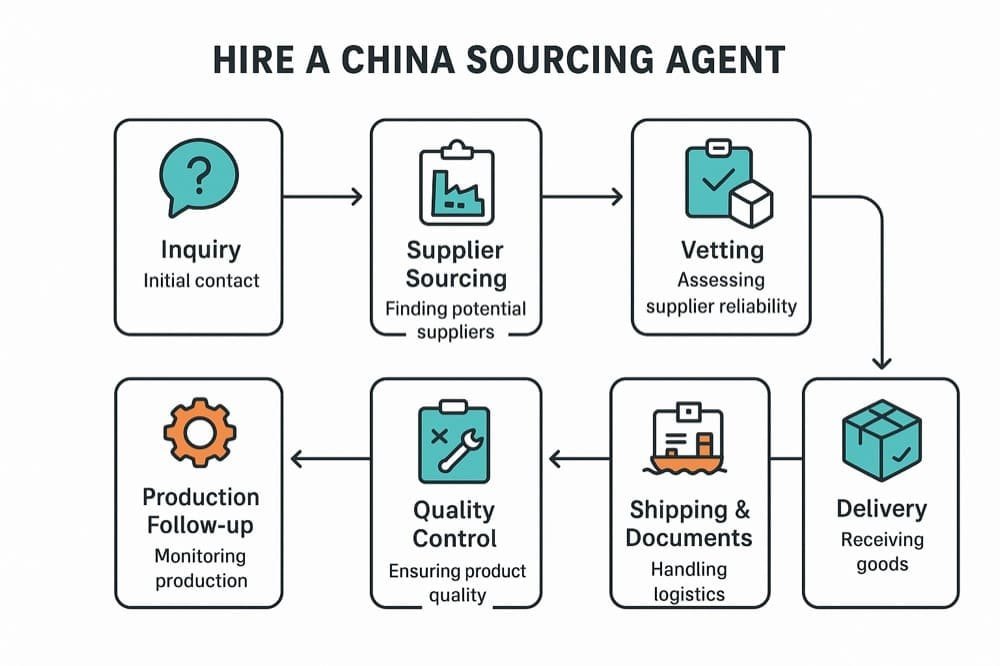
A capable agent turns opaque back-and-forth into a controlled sequence of work with deliverables you can audit. Use this table as a checklist.
Stage | What the agent does | Deliverables you should expect |
|---|---|---|
Supplier sourcing | Clarifies RFQ, searches and compares factories, requests quotes, filters by MOQ/lead time/capability | Supplier shortlist + apples-to-apples quotation sheet |
Vetting | Verifies licenses, capability signals, QC maturity, compliance risks, red flags | Vetting checklist + concise red-flag report |
Sampling | Manages sample orders, shipping, revision rounds, evaluation | Sample evaluation notes + photos + accept/reject rationale |
Production follow-up | Tracks timeline and milestones; logs issues and changes | Progress updates + issues/risk log |
Quality control (QC) | Plans inspections using AQL; checks appearance/dimensions/function/packaging/labeling | QC report with photo/video evidence + pass/fail recommendation |
Shipping & documents | Confirms Incoterm, coordinates handoffs, checks paperwork readiness | Shipping plan + documents checklist aligned to route and Incoterm |
Related internal reading:
Supplier risk control via trial order + inspection logic: How to Use Trial Orders to Test a New Chinese Supplier
Inspection-linked payment milestones (helps enforce QC gates): Inspection‑Linked Payment Milestones for China
Why buyers choose Yansourcing (what you can verify)
A good sourcing partner should be easy to audit. Here’s what you can verify when working with Yansourcing:
Evidence-first QC: AQL-based inspection plans, defect classification, and clear pass/fail handling supported by photo/video proof (when inspections are included in scope). External reference: QIMA AQL method
Risk-focused vetting: supplier red-flag reporting (licenses, capability signals, QC maturity, compliance risks)
Clean shipping handoffs: Incoterms-aligned responsibilities + documentation checklist to reduce avoidable customs delays. External reference: ICC Academy: “C” or “D” rules?
One owner across the chain: sourcing + QC + shipping coordination under one process to reduce miscommunication and timeline drift
If you want this workflow mapped to your product, request a Custom Sourcing + QC + Shipping Plan via Submit Ticket and we’ll respond with deliverables and milestones.
A lean six-step process timeline (RFQ → delivery)
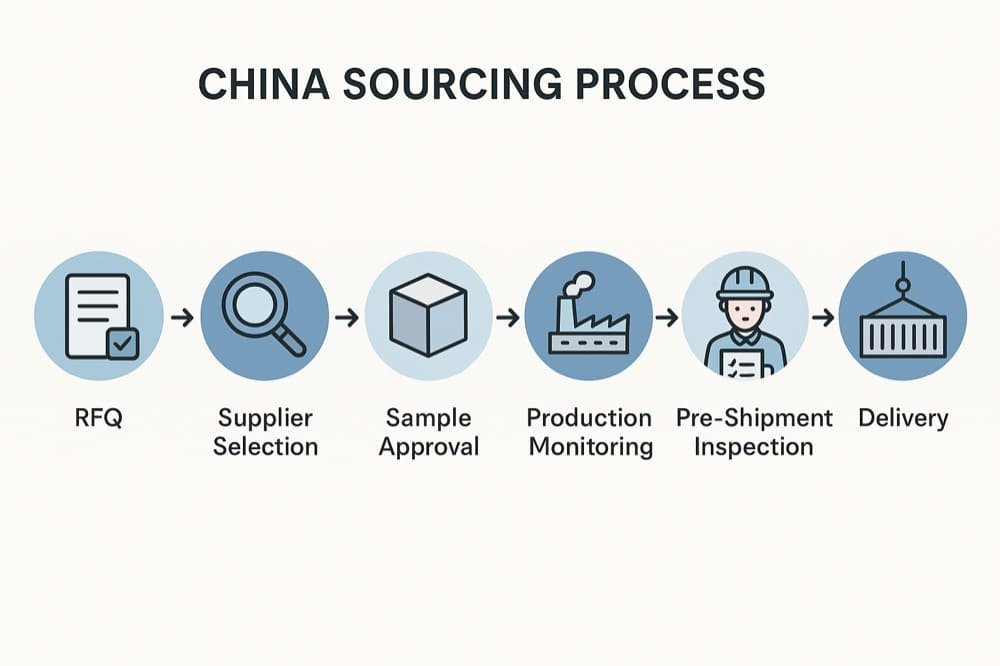
Here’s a simple sequence you can adopt internally or require any agent to follow:
RFQ and requirement confirmation — lock product specs, test methods, packaging, labeling, compliance notes.
Supplier shortlist and quotations — compare like-for-like on unit price, tooling, MOQ, lead time, terms.
Sampling and approval — document acceptance criteria, retain signed-off samples.
Production monitoring — track start, mid-point checks, and risk mitigation actions.
Pre-shipment inspection (AQL-based) — record evidence and decide pass/fail before goods leave the factory. See: Testcoo Final Random Inspection (FRI) overview
Shipping and documentation — confirm Incoterm responsibilities, prepare final docs, and execute handoffs.
Quality control with AQL — how inspections drive pass/fail decisions
AQL (Acceptance Quality Limit) is widely used to make consistent pass/fail decisions on bulk production. In practice, you define defect classes (critical/major/minor), choose an inspection level, and the AQL plan determines the sample size and acceptance/rejection thresholds (Ac/Re).
External references (industry explainers referenced in your original doc):
AQL overview: QIMA — Acceptable Quality Limit (AQL)
Inspection levels in ISO 2859-1 context: Sofeast — What is an inspection level in ISO 2859-1 and ANSI/ASQ Z1.4?
AQL is risk control, not a promise that every unit is perfect—so your real leverage comes from:
clear acceptance criteria,
documented evidence, and
defined remediation steps if a lot fails.
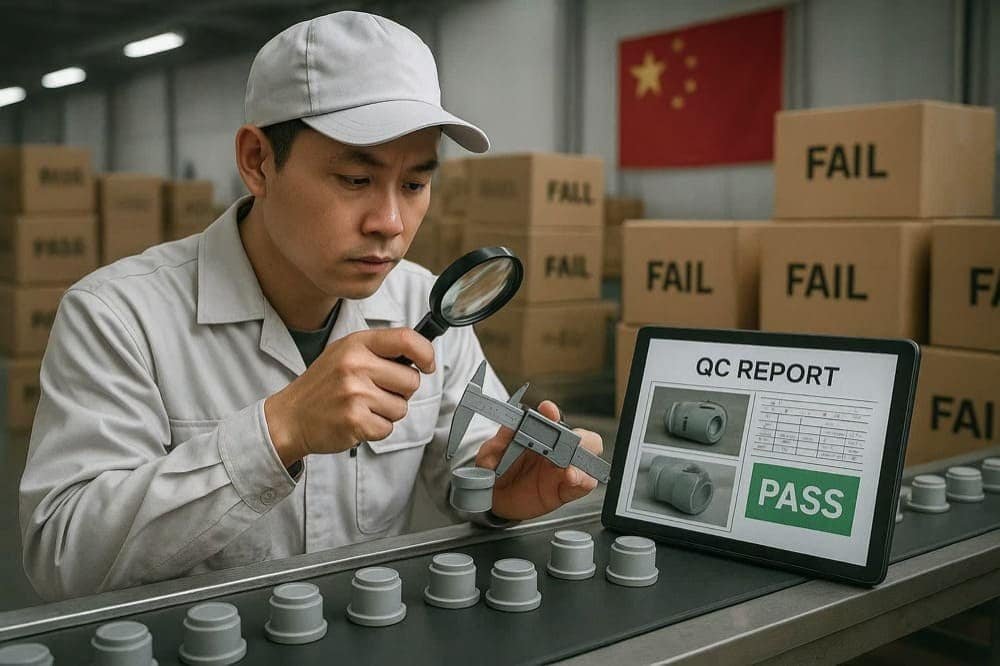
What to check and when
When to inspect
Pre-production: materials and incoming components (when risk is high)
During production (DUPRO): catch drift early
Pre-shipment (PSI): final gate before release
What to check
appearance and workmanship
dimensions and tolerances
function and safety (as applicable)
packaging integrity
labeling, barcodes, carton marks
What your QC report should include (non-negotiable)
A professional QC report should include:
time/location + inspector identity (or team)
sampling plan summary (inspection level + AQL by defect class)
measurement tables (spec vs actual)
defect list with classification + counts
photo/video evidence
clear recommendation: PASS / FAIL / HOLD FOR REWORK
Related internal reading (ties QC to commercial leverage):
If a lot fails: what happens next
If the lot fails, you have options: rework/replacement, sorting and partial shipment, or price adjustment. The key is to anchor next steps in:
your purchase contract
your acceptance criteria
your AQL plan and defect evidence
Before releasing goods, document remedial actions, re-inspection scope, and updated ship date.
Shipping & Incoterms — choosing between EXW, FOB, and DDP
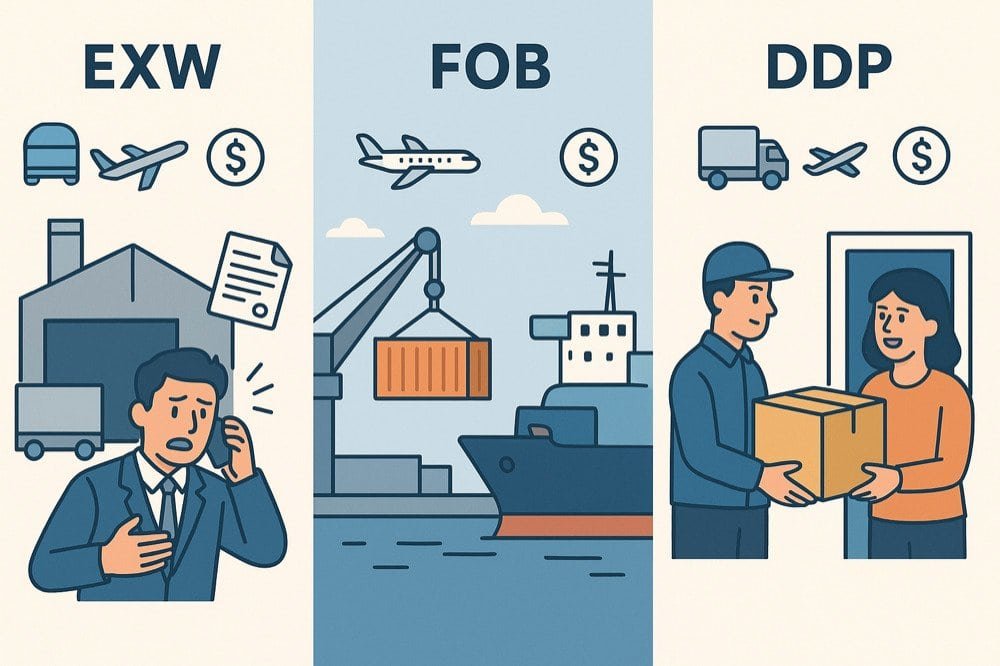
Incoterms define who does what, when risk transfers, and how costs are allocated.
Authoritative external sources referenced in your original doc:
Official ICC Incoterms hub: ICC — Incoterms® 2020
Practical responsibility framing: ICC Academy — Incoterms® 2020: “C” or “D” rules?
Specific comparison: ICC Academy — Incoterms® 2020: EXW or DDP?
Related internal reading:
Quick definitions (practical view)
EXW (Ex Works): you (buyer) handle most logistics from the seller’s premises. Maximum control, maximum coordination.
FOB (Free On Board): seller handles export clearance and loads on the vessel at the named port; you control main carriage afterward. Common and often practical for importers.
DDP (Delivered Duty Paid): seller handles export + import clearance, duties/taxes, and delivers to named destination. Simplifies handoffs but requires capability and legal feasibility in the destination (ICC warns DDP is not always feasible; DAP may fit better). See: ICC Academy — EXW or DDP
Responsibilities at a glance
Responsibility | EXW | FOB | DDP |
|---|---|---|---|
Export clearance | Buyer | Seller | Seller |
Main carriage | Buyer | Buyer | Seller |
Import clearance | Buyer | Buyer | Seller |
Duties and taxes | Buyer | Buyer | Seller |
Risk transfer point | Seller’s premises | On board at named port | At named destination |
How to choose (buyer-friendly scenarios)
Choose EXW when you want total control and have a strong forwarder/consolidator.
Choose FOB when you want control over international freight and customs/brokerage, but prefer the seller to handle export and loading.
Choose DDP when simplicity is worth the premium and the party arranging DDP can reliably handle import formalities and taxes in your country. If not, DAP may be more suitable (see ICC Academy references above).
Documents you must have
Regardless of terms, accurate paperwork is non-negotiable. Typical essentials include:
Commercial Invoice
Packing List
Bill of Lading (ocean) / Air Waybill (air)
Certificate of Origin (when required)
Other documents depending on product/category and destination
External checklists (as referenced in your original doc):
US import reference (if applicable): CBP Form 7501: Entry Summary
Pricing — common fee models, ranges, and what’s included
Most sourcing agents use one of three models, and many combine them based on complexity:
Common pricing models
Percentage of order value
Per-project fee
Hybrid model
Suggested pricing ranges (example format — replace with your actual ranges)
Option A — End-to-end sourcing + execution (percentage model)
Fee range: 5%–10% of order value (minimum fee: $100)
Typical use: repeat POs, multi-SKU, ongoing supplier management
Option B — Project scope (fixed fee model)
Supplier vetting package: USD [$200–$500]
Sampling coordination: USD [$50–$300]
Pre-shipment inspection (PSI): USD [$200–$350] per inspection
Typical use: buyers who already have suppliers but need proof + risk control
Option C — Hybrid (retainer + execution)
Monthly retainer: USD [$300–$1,000] + execution fee [5%–10%] or per-deliverable pricing
Typical use: complex or high-urgency timelines
Inclusions vs exclusions (make this explicit)
Common inclusions
RFQ clarification and sourcing strategy
supplier shortlist and quotation comparison
basic vetting checks + risk notes
sample coordination and iteration tracking
production follow-up updates (as defined)
an agreed number of QC checkpoints/inspections (if included in scope)
shipping handoff planning (Incoterms responsibilities + docs checklist)
Common exclusions
lab testing fees and formal certifications
specialized audits beyond standard scope
customs duties/taxes (depends on Incoterm and agreement)
international freight costs (depends on Incoterm and agreement)
extensive on-site work outside agreed scope
Best practice when comparing agents: ask for a one-page scope listing inclusions, exclusions, minimums, and deliverables. If it isn’t written down, it isn’t real.
Case studies — anonymized composites (with the numbers buyers care about)
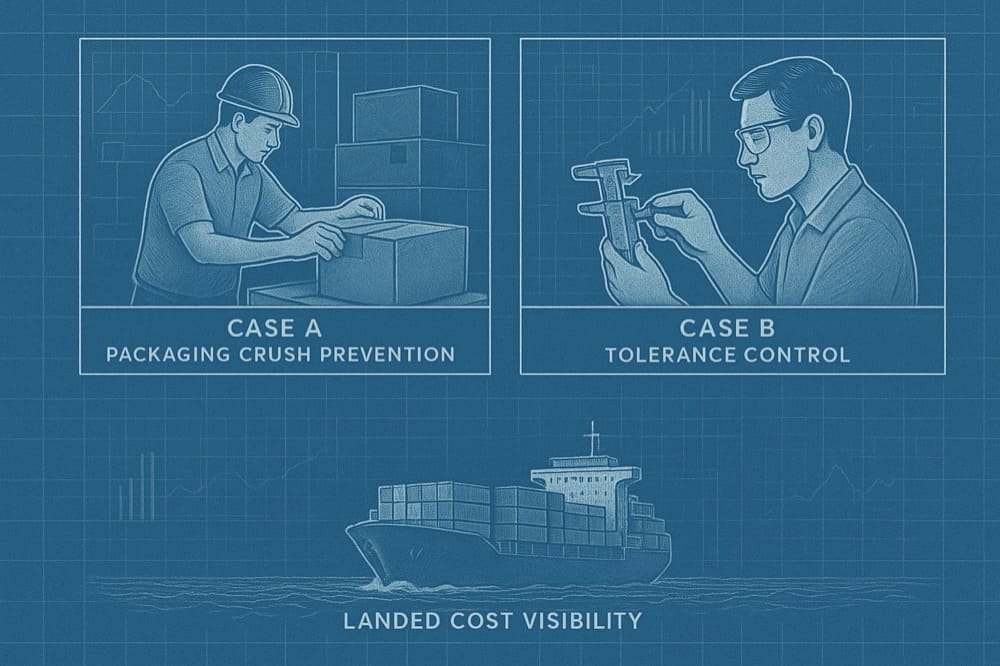
These anonymized composites illustrate typical B2B scenarios. They omit sensitive identifiers while keeping the operational facts.
Case A — Home & lifestyle to North America (multi-SKU consolidation)
Order profile: ~[X,XXX] units, [N] SKUs, MOQ [xxx]
Timeline: sampling [x] days, production [x] days
QC plan: AQL Major [2.5], Minor [4.0] (example) — see: QIMA AQL explained
Issue found: packaging crush risk; initial defect rate ~[x%] on cartons
Action: carton reinforcement + corner protection + targeted re-check
Outcome: pre-shipment inspection met thresholds; launch window protected without air-freight upgrade
Case B — Electronics accessory to the EU (OEM tolerance + labeling)
Key specs: tolerance ±[x] mm, barcode accuracy required
Process: shortlisted [3–5] suppliers; sampling surfaced tolerance drift ~[x] mm
Action: vendor scorecard; volume shifted to better performer; DUPRO + PSI implemented
Outcome: stable measurements; clean barcode scans; reduced rework and returns risk
Case C — OEM component to the Middle East (landed-cost visibility)
Goal: predictable landed-cost model; fewer handoffs
Decision: chose [FOB/DDP] based on responsibility and feasibility
Deliverables: shipping plan + documents checklist + HS code/value verification workflow
Outcome: fewer missing-doc issues; more consistent total cost visibility at destination
If you request a Custom Plan, we can share a version of similar scenarios aligned to your product category and destination. Start here: Submit Ticket.
FAQ
What’s the minimum order quantity (MOQ) requirement?
Agents don’t set MOQ; factories do. A good agent surfaces realistic MOQs during quoting and, when feasible, negotiates by adjusting packaging, materials, or combining runs.
Can you perform supplier audits or on-site factory visits?
Yes—supplier verification can include document checks and on-site evaluations when warranted. Ask for a written checklist and a red-flag report you can store.
Do you handle DDP shipping?
Many teams coordinate door-to-door delivery through freight partners. DDP requires import clearance and taxes to be managed properly at destination; if that’s not feasible, DAP may be a better alternative. Always confirm responsibilities in writing.
Helpful internal reading:
How do you ensure quality before shipment?
By planning inspections with an AQL framework, defining defect classes, and documenting evidence. Expect a photo/video-rich report with a clear pass/fail decision and next steps if remediation is needed.
External reference:
What payment terms do you recommend with factories?
It depends on leverage and risk. Common patterns include a deposit plus balance after QC and before shipment. Tie payments to milestones and inspection outcomes to align incentives.
Internal reading:
How long do sourcing and sampling take?
Simple products can move from RFQ to approved samples in a few weeks; complex OEM changes take longer. The biggest accelerators are clear specs, fast feedback, and aligned test methods.
What information do you need to start?
Product links/photos, target quantity, destination country, timeline, and any must-have requirements (packaging, labeling, compliance, testing).
Next steps — Get a Custom Sourcing + QC + Shipping Plan
If you’d like a single, actionable plan that maps suppliers, AQL inspections, and shipping handoffs to your Incoterm, request a Custom Sourcing + QC + Shipping Plan:
Contact page: Submit Ticket
Learn services scope: Our Services
Send:
Product category or reference links/photos
Estimated order quantity or MOQ target
Destination country
Preferred (or tentative) Incoterm
Contact email or WhatsApp
You’ll receive a structured response with proposed deliverables, timelines, and the first questions we need to resolve to de-risk production.
Sources & further reading (optional)
Incoterms / responsibilities (authoritative)
AQL / inspection practice
Shipping documents
US import reference (if applicable)
