
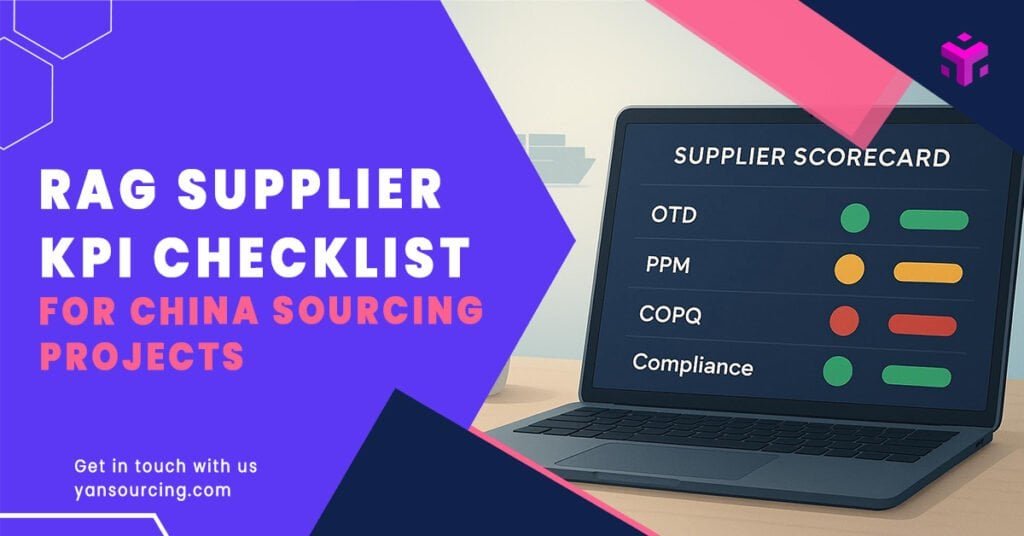
If you can’t compare suppliers with a single, objective view, you’ll end up debating anecdotes.
This supplier scorecard focuses on four pillars—On-Time, Quality, Cost, and Compliance—so you can tier China-based suppliers quickly and repeatably.
Use the red/amber/green system to flag risk, trigger actions, and decide who earns more volume vs. who needs corrective work.
How to use this checklist
- Scope: Apply the checklist monthly and review trends with a rolling 3-month average. Keep the reference rules stable for at least one quarter.
- Data hygiene: Define a single source of truth for commit dates, defect coding, and logistics milestones. Reconcile supplier self-reports with third-party inspection and ERP data.
- Tiering logic: After each monthly rollup, assign tiers. For example: Preferred (≥90 total score), Approved (75–89), Conditional (<75 or any Red in Compliance/OTD). Calibrate scores and weights by category and risk.
- Trigger discipline: Treat Red as an action signal, not a label. Freeze new POs if necessary, initiate 8D, and increase sampling until trends stabilize.
The checklist — supplier scorecard KPIs for China sourcing

Below are suggested starting thresholds. Calibrate by product complexity, order size, and customer risk tolerance. Where standards exist, we reference them.
| KPI | Definition & formula | Suggested thresholds (R/A/G) | Data sources | Cadence | Trigger actions |
|---|---|---|---|---|---|
| On-Time Delivery (OTD) | Orders delivered on or before original commit date ÷ total delivered × 100. SCOR/ASCM aligns with delivery reliability metrics. | Red <95% · Amber 95–97% · Green ≥98% | ERP orders; carrier milestones; proof of delivery | Monthly (3-mo rolling) | Red: freeze new POs; root cause + 8D; expedite open lots; consider 3rd-party reinspection. Sustained Green: reduce sampling, consider Preferred. |
| PPM (defective units) | Defective units ÷ total units × 1,000,000. | Red >1,500 · Amber 501–1,500 · Green ≤500 | Incoming QC; 3rd-party inspections; supplier tests | Per lot; monthly rollup | Red: containment; 100% re-inspection on next lot; 8D; engineering review. Amber 2 cycles: increase sampling and patrol audits. |
| AQL Acceptance Rate | Lots passed ÷ lots inspected × 100 under ISO 2859-1 sampling and agreed AQLs. | Red <85% · Amber 85–94% · Green ≥95% | 3rd-party PSI; in-house lot inspections | Per lot; monthly | Red: temporarily lot-by-lot inspection; review AQLs; process audit. Amber: supplier training; CAPA. |
| COPQ % of spend | (Internal failure + external failure) ÷ supplier spend × 100. | Red >5% · Amber 2–5% · Green ≤2% | Finance (scrap, rework, returns, claims); QMS downtime | Monthly/quarterly | Red: freeze new POs; cost recovery discussion; redesign/PPAP where relevant. Amber: cost-driver Pareto; kaizen projects. |
| Compliance Pass Rate | # audits at or above acceptable rating ÷ total audits × 100. Buyer-defined acceptance (e.g., BSCI A–C). | Red <85% or any zero-tolerance · Amber 85–94% · Green ≥95% | 3rd-party social/environmental audits; certifications; CAP status | Quarterly/annual by risk | Red: freeze sourcing; corrective audit; CAP with deadlines. Amber: follow-up audit; tighten monitoring. |
| Documentation Accuracy | Shipments with document errors ÷ total shipments × 100. | Red >5% · Amber 2–5% · Green ≤1–2% | Commercial invoice, packing list, B/L, CoO, permits | Monthly | Red: dual-review gate; pre-clearance checklist; retrain forwarder/factory docs team. Amber: spot checks; template updates. |
| Lead Time Adherence | actual cycle − quoted | ÷ quoted × 100. | Red >±20% · Amber ±10–20% · Green ≤±10% | PO dates; production milestones; ASN | |
| Price Variance vs PO | (Invoiced − PO) ÷ PO × 100. | Red >1% · Amber 0.5–1% · Green ≤0.5–1% (set per category) | PO, invoice, contracts | Monthly | Red: block payment variance; contract review; require revised quote; approval matrix. |
| NCR Acknowledge Time | Median hours to acknowledge nonconformance. | Red >48h · Amber 24–48h · Green ≤24h | QMS/NCR system; email logs | Per NCR; monthly | Red: escalate to ops director; SLA penalty. Amber: reminder automation; assign deputy contact. |
| CAP/8D Closure Time | Average days to close corrective actions by severity. | Red >60d · Amber 31–60d · Green ≤30d | CAPA tracker; 8D reports | Monthly | Red: management review; on-site support; stop-ship until containment. Amber: weekly progress calls. |
| Returns/Warranty Rate | Returns ÷ units shipped × 100. | Red >2% · Amber 1–2% · Green ≤1% (calibrate by category) | CRM/returns; e-commerce dashboards; RMA logs | Monthly/quarterly | Red: field failure analysis; design/packaging change; warranty policy review. |
Notes and sources in context:
- OTD follows SCOR/ASCM reliability conventions. See the overview of delivery reliability metrics in the SCOR Digital Standard by ASCM for alignment of on-time measures to Perfect Order Fulfillment (RL metrics). Reference: the ASCM page on the SCOR Digital Standard provides the taxonomy of reliability KPIs and targets in practice.
- PPM and COPQ conventions are defined by the American Society for Quality. For formulas and context, see ASQ’s consolidated overview of Six Sigma defect metrics and Cost of Quality/COPQ calculations.
- AQL Acceptance is based on ISO 2859-1 attribute sampling. For a practical explainer of inspection levels and Ac/Re numbers, review ISO materials and practitioner guides.
- Compliance acceptance policies often reference amfori BSCI grading (A–E) or SA8000 certification; buyers define acceptable ratings and zero-tolerance rules.
- Documentation accuracy best practices follow ICC guidance on Incoterms and trade documents; align responsibilities with your chosen Incoterms rule.
Authoritative references with descriptive anchors:
- ASCM’s SCOR Digital Standard overview on delivery reliability metrics: SCOR DS overview
- ASQ’s consolidated resource on Six Sigma and Cost of Quality/COPQ: ASQ overview of Six Sigma and CoQ/COPQ
- ISO 2859-1 sampling plan context: ISO 2859-1 standard listing
- amfori BSCI audit rating mechanics: How the BSCI audit rating works
- ICC Incoterms guidance: Incoterms 2020 overview
For readers who want practical how-to on inspections and shipping documentation in a China context, these guides offer deeper dives:
- AQL and pre-shipment inspection in China: Trial orders and testing Chinese suppliers
- Incoterms and shipping documents explained: Shipping from China to USA guide
- China sourcing strategy Strategic view and process alignment: Developing an effective China sourcing strategy
Calibrate and weight your scorecard

Your scorecard should reflect risk, complexity, and customer expectations. A few practical pointers:
- Weight by pillar: A common starting split is Delivery 30%, Quality 35%, Cost 20%, Compliance 15%—but if you sell regulated electronics, increase Quality and Compliance. Keep weights stable for a quarter.
- Avoid double-counting: If you include PPM and Returns Rate, ensure returns are not also counted in PPM for the same batch unless you explicitly want end-user failures to weigh extra.
- Smooth volatility: Use rolling 3-month averages for OTD, PPM, and COPQ. For audits, a quarterly cadence with interim CAPA tracking works well.
- Set category bands: Tighter thresholds for electronics than apparel are typical. Document any local overrides in the template, so suppliers see what “good” looks like.
- Define guardrails: Any zero-tolerance breach (e.g., critical safety defect, banned substance, forced labor finding) is an automatic Red regardless of calculated score.
Worked micro-example for target-setting
Think of it this way: if you buy molded plastic parts with simple assembly, you might set PPM Green ≤300 and AQL major 2.5%.
For a complex PCB assembly, PPM Green might need ≤100 and critical defects at 0.0% with functional tests added.
Keep the math the same; adjust the thresholds.
Example workflow: from raw data to a monthly scorecard

Disclosure: Yansourcing is our product.
Here’s the deal: one straightforward monthly cycle can keep everyone aligned without fancy BI.
- Week 1–2: Pull inputs: ERP delivery lines for OTD, third-party inspection PDFs for AQL/PPM, finance export of returns/claims for COPQ, and the latest audit/CAP status. Normalize supplier IDs and PO numbers.
- Week 2: Calculate KPIs in your sheet; apply conditional formatting to light up red/amber/green. Flag any Red in OTD or Compliance for immediate action. For inspection math basics, review the AQL resources above and the practical walkthrough in the Yansourcing inspection guide.
- Week 3: Run a 60-minute scorecard review with the supplier. If Red on OTD, agree to containment and a dated 8D; if Amber for two cycles on PPM, increase sampling to level III temporarily per ISO 2859-1 conventions; if COPQ trending up, do a Pareto of failure costs and assign owners.
- Week 4: Execute actions: freeze new POs if needed, schedule third-party reinspection for the next shipment, and track CAP/8D closure within 30 days. Update tier if the trend persists (Approved → Conditional) and re-evaluate after one more cycle.
A sourcing agent can help consolidate inspection, lab, and logistics data and enforce cadence. In that capacity, Yansourcing supports clients with month-end scorecard updates and neutral third-party checks when requested.
Next steps
Download a simple spreadsheet template, plug in your suppliers, and start with the suggested ranges above.
Keep the cadence steady for three cycles before changing weights or thresholds.
If you want help operationalizing inspections, documents, and corrective actions, consider working with a china sourcing agent.
For background reading, see our overview on developing an effective China sourcing strategy.
