

If you buy building plant from overseas, you’ve probably felt this sting: the clock on the “warranty” starts at shipment, months before the system ever runs. By the time you commission the chiller plant, half the term is gone—and defects discovered during start‑up turn into finger‑pointing.
Here’s the fix that protects owners and keeps projects on schedule: treat commissioning—and the formal Acceptance Certificate—as the warranty start. That single move, backed by clear tests and payment levers, transfers risk to where it belongs and keeps uptime front and center.
In this guide, we anchor on construction MEP/HVAC systems (chillers, AHUs, pumps, BMS) and map out practical steps for contracts, testing, spare parts, and after‑sales support. If you’re also aligning internal stakeholders on supplier selection and documentation, a practical reference point is Yansourcing’s guide to developing an effective China sourcing strategy.

To keep stakeholders aligned on scope and priorities in specs and internal docs, name the theme explicitly: MEP HVAC warranty spare parts China sourcing.
Start the Warranty at Commissioning and Acceptance (MEP HVAC warranty spare parts China sourcing)
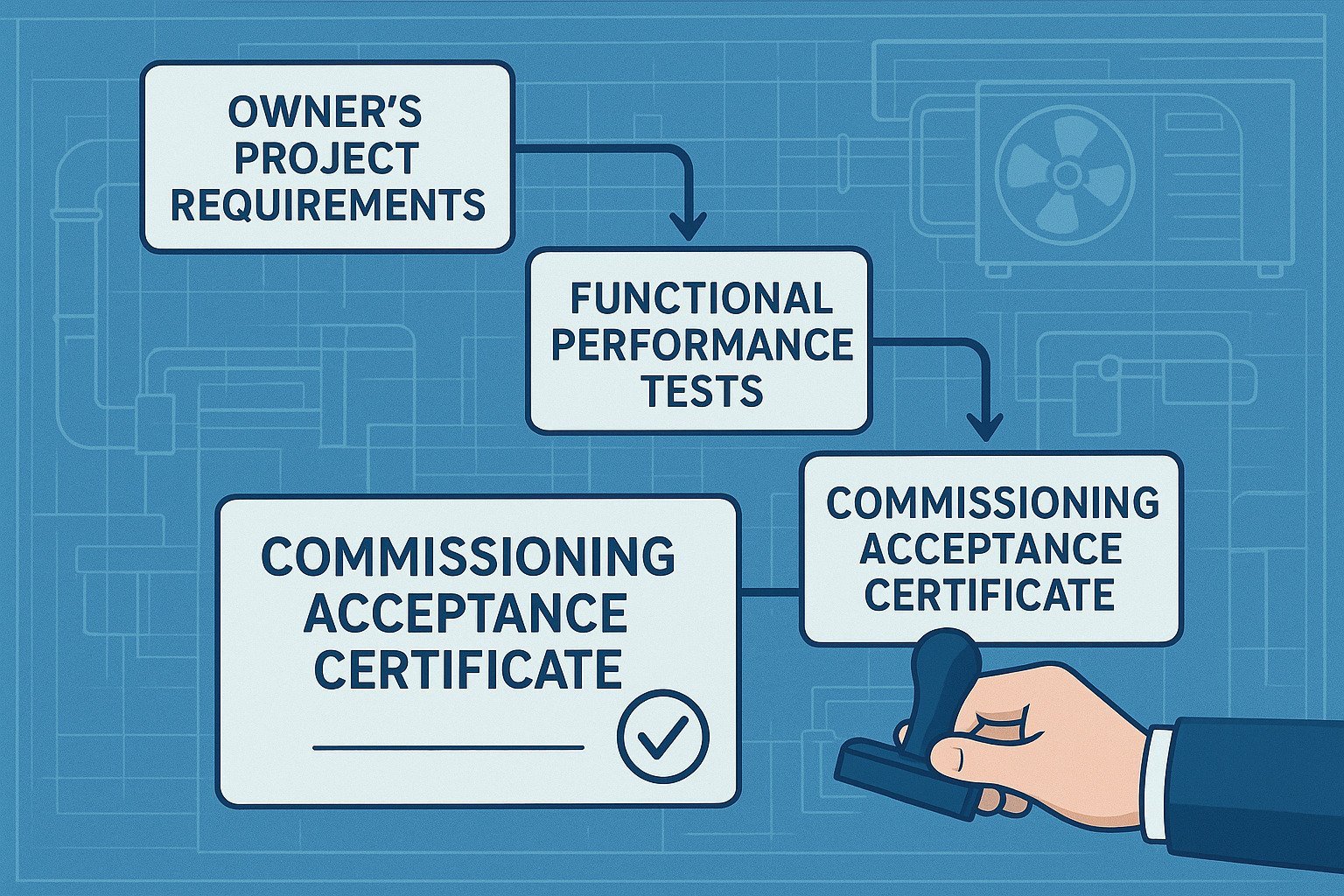
Shipment‑based start dates misalign incentives. Problems often emerge during functional performance tests, not on the factory floor.
Commissioning frameworks such as ASHRAE Guideline 0 and Standard 202 outline a documented process from Owner’s Project Requirements through functional tests and a final commissioning report, culminating in acceptance by the owner.
See ASHRAE’s overview of Guideline 0/Standard 202 for the commissioning process and deliverables in context in their instructor materials: Principles of Building Commissioning — Guideline 0 and Standard 202 (ASHRAE, overview).
On the contract side, tie warranty commencement to a formal Acceptance Certificate after successful SAT and commissioning. The FIDIC “Taking‑Over Certificate” plays a similar role in large works—its issuance triggers the Defects Notification Period and stops delay LDs.
For background, see FIDIC guidance on Taking‑Over and time/defects interactions (2018–2019 materials) and the 2017 errata linking obligations to the issuance of the Taking‑Over Certificate.
Sample non‑legal clause language you can adapt with counsel:
“Warranty Term shall commence on the date of issuance of the Commissioning Acceptance Certificate following successful completion of Site Acceptance Tests (SAT) and Functional Performance Tests, and shall not commence upon shipment.”
Why this matters operationally? Because acceptance is evidence‑based: your team signs off only after trend logs, alarms, interlocks, and capacities meet spec. If issues surface, you’re still within pre‑warranty phases and can demand corrective action before the clock starts.
From FAT to SAT to Commissioning — What “Pass” Looks Like
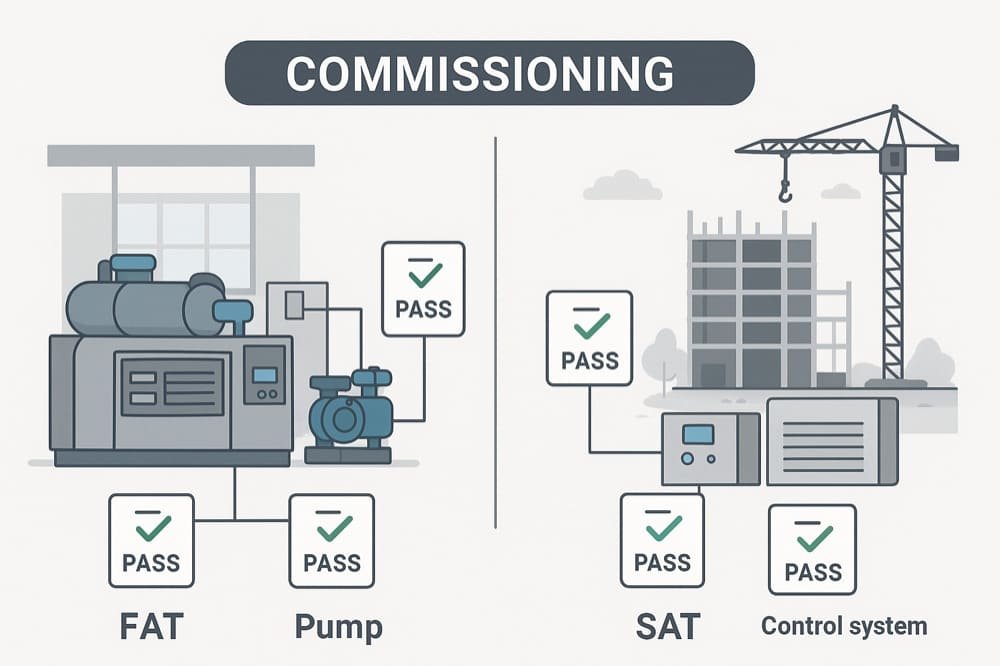
Think of FAT as proving the equipment can run to spec in a controlled environment, while SAT and commissioning prove it runs to spec in your building. Below are compact acceptance cues you can embed in submittals and test scripts without sprawling checklists.
Chillers: Verify AHRI certification coverage and submittals match nameplate; confirm factory run‑test data, evaporator/condenser ΔT and design flows; plan seasonal part‑load/IPLV verification; reference sound ratings per AHRI 1280 where applicable. See the AHRI 550/590 program page.
AHUs/Fans: Confirm rotation and vibration, coil ΔP/ΔT to design, filter seals, damper actuation, and smoke/fire interlocks; balance airflow to design CFM using TAB standards.
Pumps/Hydronics: Verify system cleanliness and flushing, strainers, NPSH/suction conditions, VFD control stability, differential‑pressure setpoints, and anchorage; hydronic balancing to design.
Controls/BMS: Complete point‑to‑point I/O; validate sequences, alarm priorities, trending/stability, safe states, and life‑safety interoperability.
Document “pass” with a commissioning report: procedures, test data, deviations, resolutions, and the Acceptance Certificate. No certificate, no warranty clock.
Spare Parts Strategy That Protects Uptime

Downtime in a chilled‑water plant is expensive. Your spare‑parts plan should mirror criticality, lead time, and failure behavior—not a one‑size list. The ABC approach from APICS/ASCM helps you prioritize control and stocking intensity across parts classes. For background on stratification and safety stock thinking, see ASCM’s inventory stratification overview and their guide on safety stock.
ABC matrix (example — tailor to your plant)
Class | Typical HVAC parts | Example rules (stocking/SLAs) | Notes |
|---|---|---|---|
A | Compressors, VFDs, PLC/DDC controllers, critical sensors/actuators, custom seals | ≥95% site or local consignment fill rate; min‑max based on MTBF and lead time; dual‑source where possible | Exchange/loaner pool eligibility; monitor obsolescence |
B | Fans, coils, contactors, starters, belts | 85–90% fill rate; periodic review; vendor‑held stock acceptable with SLA | Aggregate buys; plan seasonal demand |
C | Fasteners, fittings, common filters/gaskets | Order on demand; relaxed review cycles; bin controls | Bundle with routine POs |
Implementation tips: Build a critical spares register with lead times, MTBF, location, and supplier contacts. Tie reorder points to service levels rather than guesses. For A‑class items with long lead times, negotiate consignment stock in‑country or a loaner/exchange pool to cap MTTR.
If you’re planning to hold critical spares near site (or consolidate parts before forwarding), you’ll typically need a warehousing/dispatch workflow; Yansourcing describes a related fulfillment model under dropshipping (storage, packing, and onward shipping concepts). Keep firmware images/config backups for controllers with escrow terms if proprietary.
After‑Sales, RMA, and SLAs That Actually Work
When something fails, clarity beats heroics. Define a simple, enforceable flow for triage and remedy—then measure it. IFMA’s facilities guidance highlights tracking operational KPIs like MTTR, MTBF, and planned maintenance completion; see their overview on top KPIs for facility managers.
RMA/on‑site support model, in brief: Remote triage within a defined response window with photos, alarms, trend logs, and serials; decision on field fix vs. exchange vs. depot repair. If exchange, ship from local stock/consignment by same‑day cutoff; return defective unit into RMA loop with a root‑cause report.
On‑site, set arrival targets by criticality and require a first‑time‑fix diagnostics checklist; escalate to OEM engineer if controls issues persist. Track response, on‑site arrival, MTTR, first‑time‑fix, and parts fill rate; review monthly and trigger corrective actions if misses persist.
Contract Levers for Real Risk Transfer

Structure the deal so testing and performance—not paperwork—determine payment and risk.
Retention and release: Hold 5–10% retention from progress payments. Release 50% on acceptance (post‑commissioning) and the balance at DNP expiry or after seasonal tests. Public‑sector practices vary; see the U.S. federal context in FAR 32.103 on construction progress payments/retainage.
Escrow and jurisdiction: Use third‑party escrow for retention and, where software or firmware is critical, for source code/keys. Define release triggers tied to Acceptance and DNP closeout. For cross‑border enforceability and arbitration seat options, review ICLG’s technology sourcing overview for Hong Kong.
Liquidated damages and seasonal testing: Keep LDs in place for late SAT/commissioning and incomplete seasonal tests. Accept when evidence shows performance under representative conditions.
AQL and incoming quality: For incoming inspections, specify ANSI/ASQ Z1.4 attribute sampling for defined AQLs and criticality tiers; see ASQ’s overview of Z1.4/Z1.9. Tie acceptance to both sampling results and functional checks, not to delivery alone. If your team needs a concrete inspection workflow (what gets checked, when, and what evidence you receive), see Yansourcing’s overview of manufacturing and inspection.
Clause snippets (non‑legal; consult counsel): Retention release — “Retention shall be released 50% upon Acceptance and 50% upon expiry of the Defects Notification Period or completion of seasonal performance tests, whichever occurs later.” Escrow — “Retention and any software escrow shall be administered by a neutral third party, with release events tied to Acceptance Certificate issuance and documented defect closure.”
A Quick ROI Lens on Commissioning‑Tied Warranties
Here’s the deal: downtime cost usually dwarfs the carrying cost of retention or local spares. Imagine a 2,000‑ton chiller plant serving a hospital. One day of outage—temporary cooling, patient risk mitigation, contractor overtime—can run into six figures.
Holding 5% retention for several months and funding a modest A‑parts pool often costs less than a single unplanned outage. Which side of that bet would you rather be on?
Practical Example — Coordinating Acceptance and Spares via a China Sourcing Partner

Imagine you’re procuring packaged AHUs and pumps from multiple Chinese manufacturers. A neutral sourcing partner can help orchestrate the quality and commercial steps without changing your contract intent.
Before shipment, they witness FAT against submittals, confirm AHRI documentation where applicable, and capture serials and firmware versions. During shipping and payment, retention is placed in third‑party escrow with release tied to post‑commissioning Acceptance.
On site, they coordinate SAT checklists, tabulate issues, and stage consignment A‑class spares locally so exchanges ship the same day.
For example, Yansourcing can act as the facilitator across these steps—coordinating FAT/SAT documentation, handling escrow logistics through neutral providers, and arranging consignment stock—while the owner’s commissioning agent retains authority over Acceptance. This keeps roles clear and avoids promotional claims, while giving the project a single coordination touchpoint.
What to Do Next
Write commissioning‑based warranty language into RFQs and contracts and map the Acceptance Certificate to retention release. Build your FAT/SAT/commissioning scripts now; don’t wait for delivery. Stand up an ABC spares plan with consignment or loaners for A‑parts.
Define after‑sales SLAs and KPIs; review them monthly with the vendor. If you want a quick reference for what inspection evidence to request during production and before shipment, you can also bookmark Yansourcing’s piece-by-piece inspection guide for your internal checklist.
Finally, echo the project’s priority phrase once more in your internal handover pack: MEP HVAC warranty spare parts China sourcing.
Legal note: The sample clauses and practices above are practical examples, not legal advice. Always consult qualified counsel to tailor language, governing law, and enforcement mechanisms for your project and jurisdiction.
