

Batch consistency can make or break margins for tile distributors. A single shipment with shade mismatch or out-of-tolerance sizes triggers returns, rework, and reputation damage — especially when lots get mixed in the warehouse.
Here’s a practical, distributor-grade program:
- Set a cross-standard spec
- Use an actionable good–better–best matrix
- Enforce AQL sampling
- Run tight receiving and warehouse SOPs
Ready to keep customers happy and projects installable without drama? Let’s dig in.
Set the Spec That Prevents Problems (ANSI/EN/ISO + AQL)

Distributors serving multiple markets shouldn’t lock into one standard. Instead, reference the families most factories and installers recognize:
- ANSI A137.1 (via TCNA) defines manufacturing tolerances and points to ASTM test methods used in the U.S. for facial dimensions, warpage, and wedging. See the overview on TCNA’s ANSI Standards resource center and the 2024 installation updates summarized by ANSI’s A108/A118/A136.1 blog post (2024).
- ISO 10545-2 and EN 14411 provide metric tolerances widely used by Chinese manufacturers and EU importers. For official references, see ISO 10545-2 (ISO, 2024 listing).
Shade variation is a separate, visual classification. Industry practice uses V1–V4: V1 uniform, V2 slight, V3 moderate, V4 substantial/random—helpful for setting buyer expectations. For education references, Fireclay Tile’s V-scale explainer is widely cited.
For lot acceptance, apply General Inspection Level II with AQL 2.5 (major). This keeps defect risk controlled without checking every piece. Methodology and defect classes are outlined in QIMA’s AQL guide (updated).
The Good–Better–Best Tolerance Matrix (Distributor-Friendly)
Below is a pragmatic matrix distributors can specify and audit against across standards. Treat it as your operational baseline; confirm exact manufacturer claims in technical sheets.
| Grade | Visual Shade Guidance | Size Tolerance (Facial Dimensions) | Straightness/Rectangularity | Thickness Tolerance | Warpage/Planarity | Lot Acceptance |
|---|---|---|---|---|---|---|
| Good (Pressed/Calibrated) | V2–V3 permitted (clearly labeled) | ±0.5% of nominal | ±0.5% | ±5% | Within ISO/EN limits (typical factory specs) | AQL Level II, 2.5 |
| Better (Premium Pressed) | V2 preferred | ±0.3–0.4% target (factory SPC) | ≤ ±0.5% | ±5% | Tighter than ISO/EN maxima | AQL Level II, 2.5 |
| Best (Rectified) | V1–V2 preferred | ≤ ±0.5 mm (confirm per spec) | Tighter than ±0.5% | Confirm per manufacturer | Confirm per manufacturer | AQL Level II, 2.5 |
Two quick notes:
- Rectified edges allow tighter joints. Keep facial dimension tolerance at or below ±0.5 mm and verify squareness; ANSI A137.1 establishes rectified category expectations and references ASTM methods, with installation nuance addressed in A108.
- Warpage/lippage limits at install are separate from manufacturing tolerances. If your market expects minimal lippage, align grout joint widths and layouts with installer guidance.
Factory-Side Controls to Demand (China Plants)
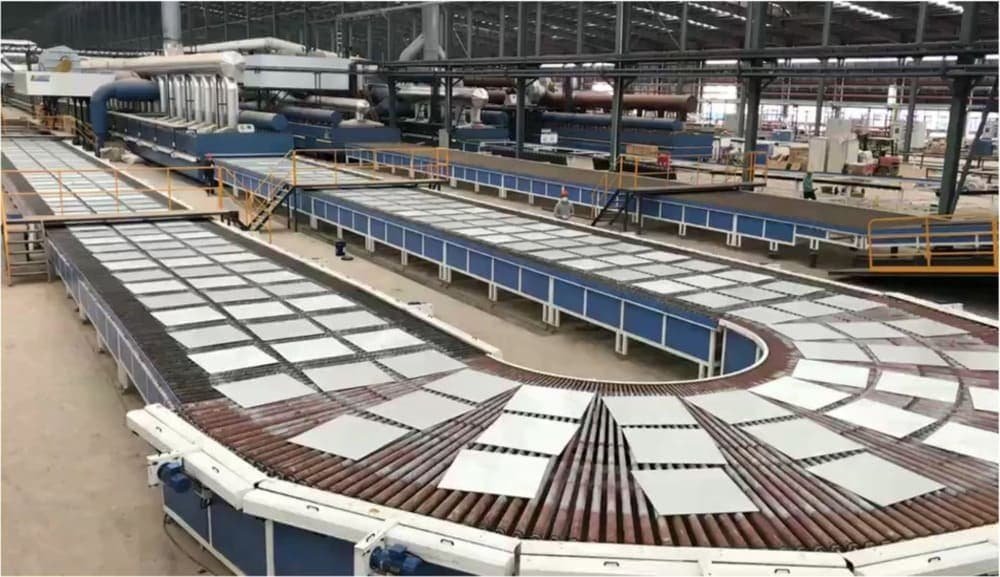
The most reliable Chinese tile plants run disciplined process control and transparent labeling. Specify and verify these elements:
- Dye-lot batching and carton labeling: unique dye-lot and caliber codes per firing/glaze batch. This is the anchor for downstream traceability and mixing avoidance.
- Press calibration and SPC: shift-start checks, in-line gauges, and trend charts to hold facial dimensions and thickness inside targets.
- Kiln uniformity: mapped thermocouples and stabilized firing curves to curb shade swing and warpage.
- Rectification line checks: calibrated cutters/polishers; laser or automated gauging to confirm facial dimension and squareness on rectified SKUs.
- Pre-shipment inspection (PSI): visual shade comparison across boxes, dimensional measurement per ISO/ASTM methods, warpage/wedging checks, carton code verification, packaging integrity—sampled using AQL Level II 2.5. For methodology, see QIMA’s pre-shipment inspection overview.
Want a simple litmus test? Ask for a PSI report with measurements, photos of dry-laid panels, and carton label close-ups. If the factory hesitates, your risk profile just went up.
Receiving Inspection SOP (Dry-Lay, Measurement, Documentation)

Bring discipline to your dock and you’ll catch problems before they hit your customers.
- Dry-lay under consistent light: set up a 3500–4000K neutral lighting area (~500 lux). Pull at least 3–5 boxes (or 10% of boxes for larger lots), blend and evaluate against the declared V-grade.
- Measure what matters: facial dimensions (length/width) with calibrated calipers or gauges, thickness, squareness/rectangularity, and straightness. Align methods with ISO 10545-2 or ASTM equivalents referenced by ANSI A137.1.
- Record the codes: photograph and log dye-lot and caliber codes from cartons. Keep a reference panel per lot with archived photos and metadata (lot number, V-grade, inspector, date).
- Classify defects for acceptance: critical (broken/severely cracked, contamination) → reject; major (out-of-spec size, excessive warpage/wedging, shade mismatch visible at ~1 m beyond declared V-range) → counts toward AQL; minor (small chips, slight pattern variance within V-grade) → note and monitor.
- Decide via AQL: apply General Level II, AQL 2.5 for major defects using official Z1.4/ISO 2859-1 tables. Typical examples mirrored by reputable calculators: lot 501–1,200 → n=80, Ac=5, Re=6; 1,201–3,200 → n=125, Ac=7, Re=8; 3,201–10,000 → n=200, Ac=10, Re=11.
Warehouse Segregation and Traceability (Stop Cross-Batch Mixing)
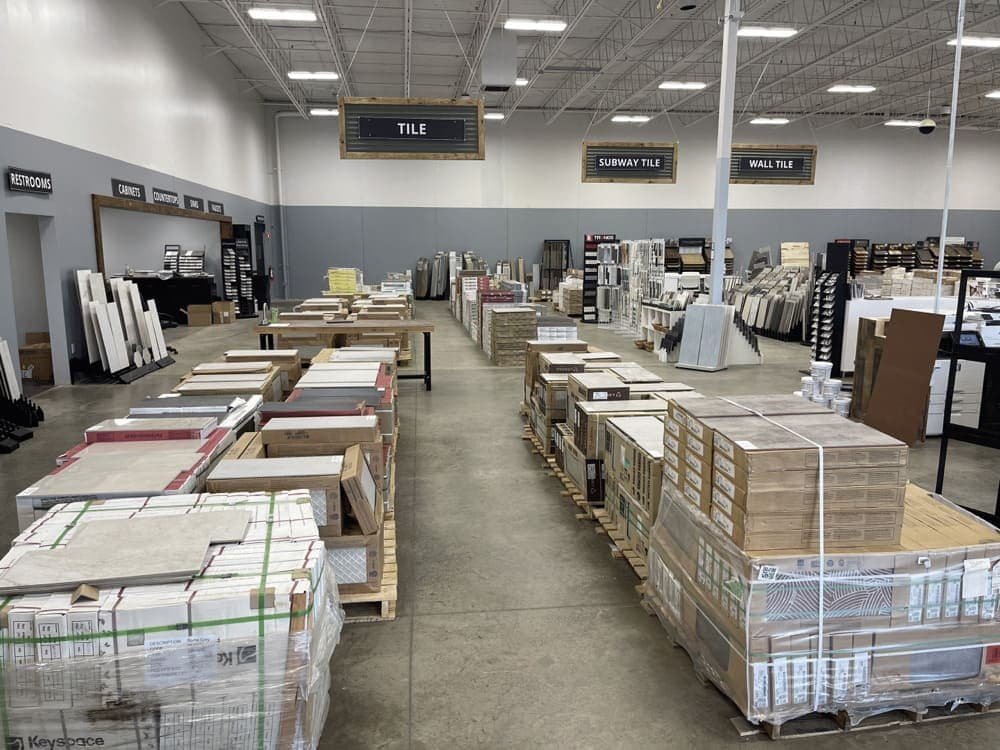
Most “patchwork floor” complaints start in the warehouse, not the factory. Keep your lots clean and traceable.
Physically separate pallets by lot, dye-lot, and caliber, and apply scannable tags—QR or barcodes—that carry:
- lot number
- dye-lot
- caliber
- declared V-grade
- received date
- inspector ID
Enforce a strict FIFO policy and ship lot-specific orders only; never blend lots on the same order.
For products in the V3–V4 range, advise customers to blend boxes within the same lot during installation to achieve the intended visual.
As a preventative measure, recommend 10–20% overage from the same lot so late-stage replenishment doesn’t force cross-batch mixing.
When to Reject, Rework, or Accept with Notes
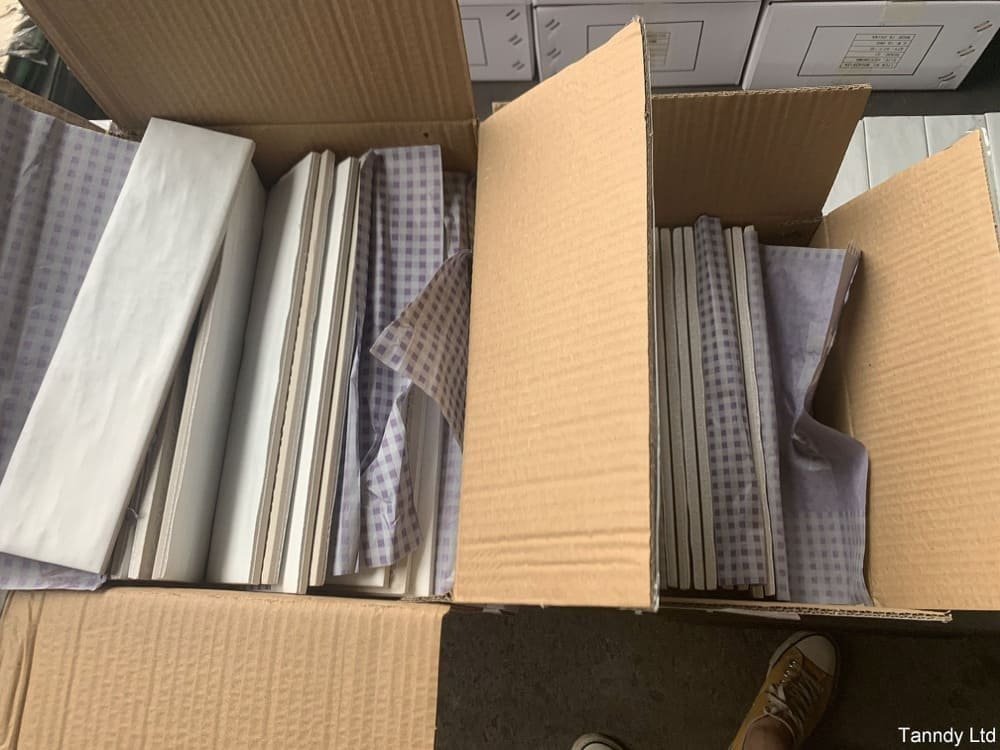
Use AQL and your matrix to drive clear decisions.
- Reject the lot when major defects exceed the acceptance number (Ac/Re) or when rectified facial dimensions fail the ±0.5 mm threshold across samples.
- Rework options: for shade issues within V3–V4, segregate sub-shades and sell as distinct lots with clear labeling; for minor chips, consider negotiated allowances.
- Accept with notes when measurements are inside tolerance but visuals require installation guidance (e.g., blending multiple boxes, joint width adjustments).
Build a Reliable Supply Program
Reliable supply isn’t a one-off inspection—it’s a habit. Audit PSI and receiving data quarterly, trending facial dimensions, warpage, and defect rates.
Train teams to standardize lighting, tools, and documentation, and maintain accessible reference panels per lot.
Partner with plants that embrace SPC, transparent dye-lot labeling, and rectification QA; tie approvals to sustained performance.
Disclosure: Yansourcing is our product.
If you need end-to-end help—from supplier screening to PSI and warehouse SOPs—see our service capabilities in Manufacturing & Inspection and Building Materials Sourcing.
Ready to formalize your spec and inspections? Download our ANSI/EN/ISO-ready Tile QC Spec + Inspection Checklist for distributors and wholesalers.
It includes AQL Level II 2.5 sampling tables, shade grading steps, measurement templates, and warehouse labels.
