
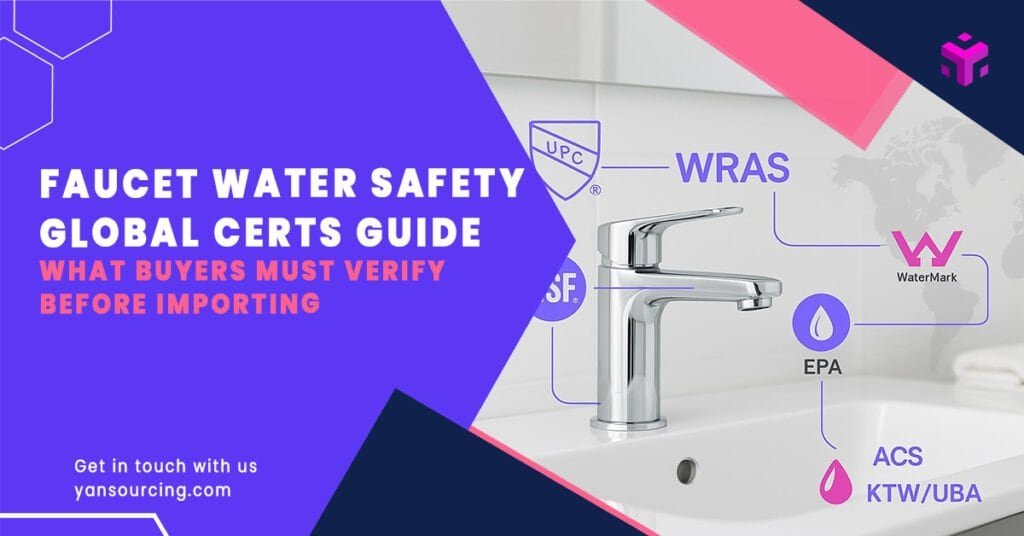
If you want one faucet SKU to work in three or four export markets, the rules don’t line up neatly.
US/Canada inspectors often look for cUPC and health marks;
the UK talks Regulation 4 and WRAS;
France insists on ACS;
Germany checks KTW-BWGL;
Australia/NZ won’t allow installation without WaterMark and will soon require lead-free by design.
Here’s a practical, side-by-side guide that shows:
- what each regime covers,
- which parts are mandatory, and
- how to plan a single test program that clears multiple markets without redesigning your product twice.
At-a-glance comparison (what each regime actually covers)
| Market/Regime | Mandatory? | Scope focus | Core standards you’ll touch | Lead/leachate expectations | Validity/marking | Typical lab timeline |
|---|---|---|---|---|---|---|
| US/Canada – cUPC (IAPMO) | Commonly required for legal installation | Mechanical safety/performance | ASME A112.18.1/CSA B125.1 for faucets/mixers | Works alongside NSF/ANSI/CAN 61 Section 9 (leachate) and 372 (≤0.25% lead content) | cUPC mark on product/packaging; surveillance per listing | ~6–12 weeks |
| US/Canada – NSF/ANSI/CAN 61 & 372 | Materials/health required for potable water contact | Materials and leachate; lead content | Section 9 for mechanical devices; 372 for lead ≤0.25% (weighted average) | Reduced Q limits effective 2024 for Section 9 | Listing + documentation; periodic audits | ~8–16 weeks |
| US – EPA WaterSense (bathroom faucets) | Voluntary efficiency label | Water efficiency and performance | Conforms to ASME A112.18.1/CSA B125.1; faucet max flow | 1.5 gpm today; Draft v2.0 proposes 1.2 gpm at 60 psi (2024 draft) | WaterSense label; certification body listing | ~6–10 weeks |
| UK – Regulation 4 compliance via WRAS | De-facto accepted route | Materials hygiene + mechanical | BS 6920 for non-metallics; aligns with EN mechanical | Materials must pass BS 6920; product approval 5 years typical | WRAS approval letter/number; 5-year renewal | ~8–14 weeks |
| EU mechanical (EN) | Market expectation | Mechanical durability/performance | EN 817 (mixers), EN 1111 (thermostatic), EN 200 (dual-control) | Lead/leachate handled by national regimes (e.g., ACS/KTW) | Test reports; used to support market access | ~6–12 weeks |
| France – ACS | Mandatory for potable water contact | Hygiene, migration, taste/odor, micro | ACS per Ministry guide; accredited labs | Valid 5 years; migration/organoleptic criteria | ACS certificate; renewal at 5 years | ~8–12 weeks |
| Germany – KTW-BWGL (UBA) | Mandatory for materials in contact with DW | Materials hygiene; positive lists; DoC | KTW-BWGL evaluation criteria; elastomers Annex D timeline | DoC + positive list compliance; factory controls | DoC with supporting tests; audits as required | ~8–14 weeks |
| Australia/New Zealand – WaterMark | Mandatory for installation | Mechanical + hygiene + conformity | AS/NZS 3718 (tapware), AS/NZS 4020 (contact with DW) | National lead-free ≤0.25% effective May 1, 2026 | WaterMark on product; CAB surveillance | ~6–12 weeks |
| Australia/New Zealand – WELS | Mandatory registration/labeling | Water efficiency | WELS registration for taps/mixers; star label with flow | Works with WaterMark prerequisite | Star label on product/packaging; annual renewal window | ~2–6 weeks (post-test) |
Note: Timelines reflect typical accredited lab lead-times for a single faucet family with representative models; your specifics may vary.
United States and Canada: cUPC, NSF 61/372, and WaterSense

What cUPC Covers
cUPC is a certification mark administered by IAPMO R&T. For faucets and mixers, it demonstrates conformance to the harmonized ASME A112.18.1/CSA B125.1 mechanical and safety requirements recognized by many Authorities Having Jurisdiction.
See IAPMO’s program overview via the official IAPMO R&T portal in the United States and Canada on the IAPMO R&T site: the cUPC program is documented by IAPMO R&T and referenced by the Uniform Plumbing Code.
Authoritative reference: the certifier’s portal, IAPMO R&T — the official cUPC program details reside on IAPMO R&T’s certification portal.
Health and Lead Requirements
For potable water contact, importers typically pair cUPC with health approvals.
According to NSF’s program overview, NSF/ANSI/CAN 61 Section 9 for mechanical plumbing devices uses reduced Q limits effective 2024.
NSF/ANSI/CAN 372 defines a weighted average lead content ≤0.25% across wetted surfaces.
WaterSense Label (EPA)
EPA’s WaterSense label for bathroom faucets is voluntary but often required by programs and retailers.
As of 2024/2025, the current spec caps maximum flow at 1.5 gpm @ 60 psi, and the EPA released a Draft Version 2.0 proposing 1.2 gpm, with scope and testing clarifications.
See the official EPA page for
WaterSense bathroom faucets for the current specification status and program details.
Marking and Surveillance
Keep the cUPC shield legible on the product or packaging, ensure your labeled maximum flow matches your WaterSense/WELS plan, and maintain records for periodic audits.
Common Pitfalls
- Failing NSF 61 Section 9 because of leachate from cartridges, hoses, or lubricants
- Not aligning WaterSense flow with aerator selections
- Using alloys that meet 372 by composition but fail Section 9 leachate under reduced Q limits
UK and the wider EU: WRAS, BS 6920, and EN mechanical standards
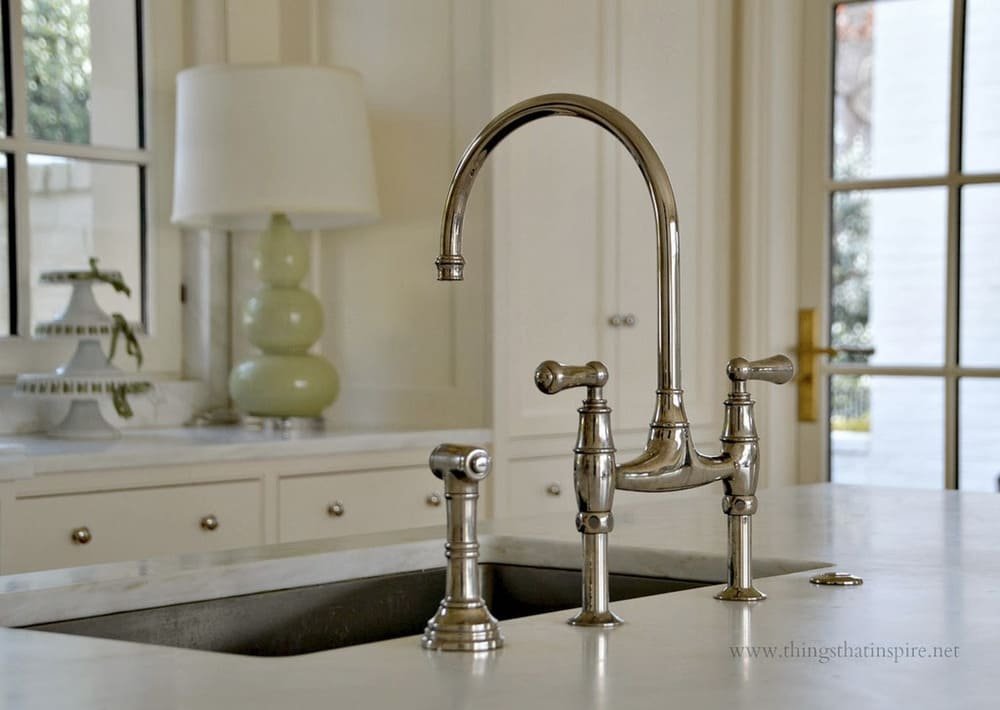
UK Acceptance in Practice
The UK’s Water Supply (Water Fittings) Regulations require fittings to be “of an appropriate quality and standard.”
In practice, WRAS product approval is a widely accepted route to show compliance with Regulation 4, with approvals generally valid for five years.
For context and regulatory alignment, see Kiwa’s overview explaining how UK Regulation 4 compliance is commonly demonstrated through WRAS approval: Kiwa’s Regulation 4 compliance explainer.
Materials Hygiene
Non-metallic (rubbers, plastics, coatings) must satisfy BS 6920 suitability for contact with water intended for human consumption.
Many products use WRAS material approvals or BS 6920 test reports as evidence during product approval.
Mechanical Performance Across EU
While the UK is separate from the EU, mechanical performance for mixers in Europe is typically shown via EN standards:
- EN 817 for single-handle mechanical mixing valves
- EN 1111 for thermostatic mixers
- EN 200 for dual-control mixers
Common Pitfalls
- Subassemblies (e.g., o-rings, seals) that pass one market’s positive list still failing BS 6920 organoleptic tests
- Not planning for five-year re-approval windows
France: ACS
ACS (Attestation de Conformité Sanitaire) is mandatory in France for products and subassemblies that include at least one organic component contacting potable water.
The process checks composition/migration, taste/odor, and microbiological criteria, and certificates are typically valid for five years.
The French Ministry of Health’s official good practice guide outlines scope, laboratory approval, and documentation requirements in detail: see the 2025 edition, the French Ministry’s ACS good practice guide.
Practical tips:
- Map your bill of materials (BOM) so each non-metallic part can be traced to an accepted formulation with migration data.
- Keep your ACS dossier aligned to forthcoming EU Drinking Water materials rules, which will gradually harmonize hygiene requirements across Member States.
Germany: KTW-BWGL and UBA declarations
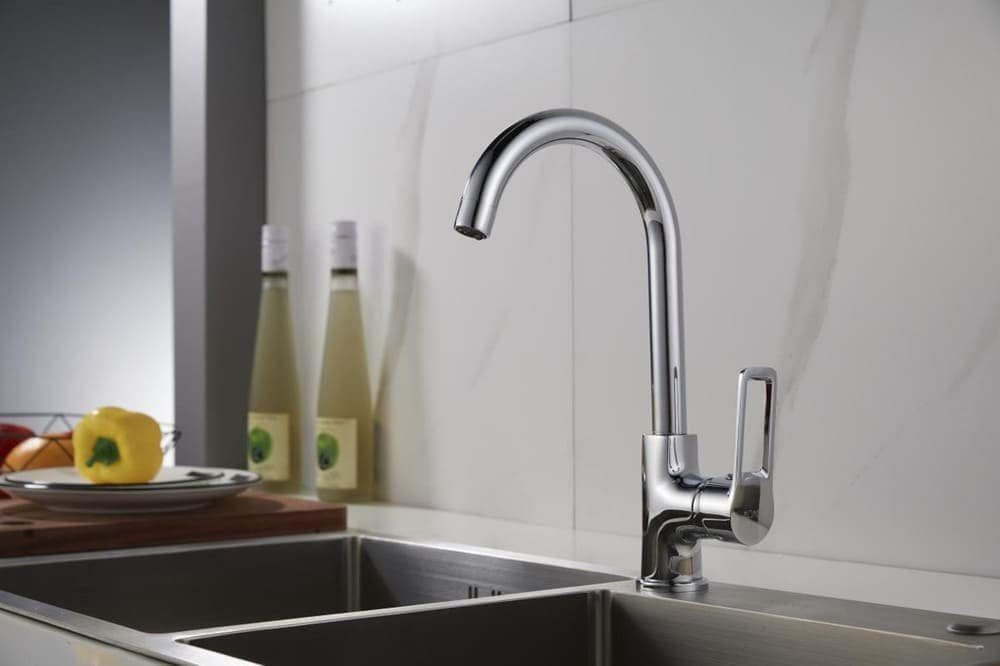
Germany enforces hygienic suitability for materials in contact with drinking water via the UBA’s KTW-BWGL evaluation criteria.
The framework hinges on:
- positive lists,
- migration limits, and
- a Declaration of Conformity (DoC) that ties test data to your factory controls.
Elastomers have their own annex and timeline requirements; industry notices have discussed transitions into 2025–2026, so confirm the current effective dates before locking your plan.
For official context, consult the German Environment Agency’s page on evaluation criteria and guidelines.
Practical tips:
- Pre-qualify elastomers, lubricants, and coatings against KTW-BWGL positive lists before committing to tooling.
- Align DoC responsibilities with your OEM: who owns the recipe, who controls supplier changes, and how to document lot traceability.
Australia and New Zealand: WaterMark and WELS
WaterMark certification is mandatory for installation in Australia (and recognized across New Zealand).
For tapware, you’ll typically test to:
- AS/NZS 3718 (mechanical/functional)
- AS/NZS 4020 (contact with drinking water)
Certified products carry the WaterMark and undergo surveillance by accredited Conformity Assessment Bodies.
The official scheme is documented by the Australian Building Codes Board at the WaterMark certification scheme home.
- Lead-free transition: Australia requires copper-alloy plumbing products to meet ≤0.25% weighted average lead content by May 1, 2026. If you’re designing now, choose alloys and components that already meet this threshold to avoid rework.
- WELS: Taps and mixers also require WELS registration and labeling. The label shows star rating and exact flow rate. Registration commonly relies on WaterMark test evidence and has an annual renewal window.
One multi-market test plan that actually works
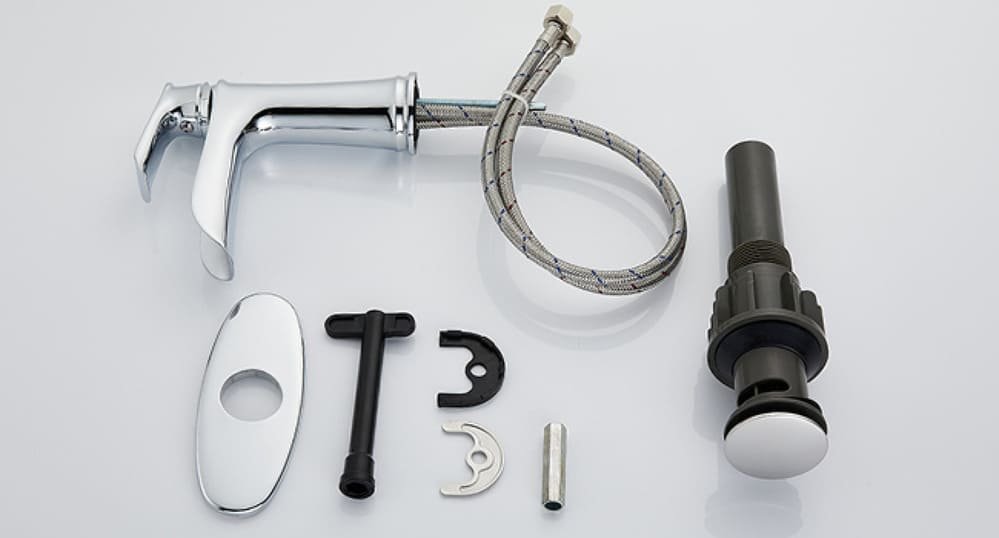
Think of your faucet like a bundle of sub-systems: cartridge, body/alloy, elastomers and seals, hoses, aerator/flow control, lubricants, and finishes.
A multi-market plan aligns each of these to the strictest plausible requirement and then maps tests to minimize duplicate work.
1. Materials and health first
Materials and health first: Pick a brass alloy and wetted BOM that meets NSF/ANSI/CAN 372’s ≤0.25% lead content and performs under NSF 61 Section 9’s reduced Q regime.
Cross-check non-metallics against BS 6920 evidence for the UK and KTW-BWGL positive lists for Germany.
If a part can’t clear KTW-BWGL, it’s a red flag for ACS as well.
2. Mechanical endurance
Design to pass ASME A112.18.1/CSA B125.1 endurance in North America and EN 817 endurance in Europe.
Fortunately, cartridges proven in EN often perform well in ASME tests when the operating envelope (pressure/temp) is matched early.
3. Water efficiency variants
For bathroom faucets, plan two aerator SKUs:
- One tuned to WaterSense at today’s 1.5 gpm with a path to 1.2 gpm if EPA finalizes Draft v2.0.
- One tuned to your target WELS star rating.
Keep valve sizing and flow passages consistent so swapping aerators doesn’t alter safety/performance tests.
4. Documentation and marking
Prepare a shared documentation set: material lists, DoCs (UBA/KTW-BWGL), lead-free declarations, WRAS or BS 6920 evidence, ACS dossier, WaterMark paperwork, and labeling artwork.
Align packaging so regional marks are correct without confusing installers.
5. Lab bookings and chain-of-custody
Reserve slots with accredited bodies early (NSF, IAPMO, Kiwa, SGS, TÜV, Intertek).
Ship sealed, production-equivalent samples and keep a strict chain-of-custody to avoid “sample/drawing mismatch” rejections.
Indicative certification costs and lead-times
These are typical industry ranges; always request formal quotes based on your family matrix and evidence reuse.
| Regime | Indicative test/cert cost (USD equiv.) | Typical lab/cert time |
|---|---|---|
| cUPC (IAPMO) | $5,000–$15,000+ per product family | 6–12 weeks |
| NSF/ANSI/CAN 61 & 372 | $7,000–$20,000+ (often bundled) | 8–16 weeks |
| WaterSense (bathroom faucets) | $3,000–$10,000+ | 6–10 weeks |
| UK WRAS/Reg 4 route | $3,700–$12,500+ | 8–14 weeks |
| France ACS | $3,200–$8,500+ | 8–12 weeks |
| Germany KTW-BWGL | $4,200–$10,500+ | 8–14 weeks |
| WaterMark (often with WELS) | $2,500–$7,500+ | 6–12 weeks |
Common failure modes—and how to avoid them
- Lead leachate exceedances under NSF 61 Section 9’s reduced Q: Tune alloy/processing, switch to certified cartridges/hoses, and retest after seasoning.
- BS 6920 organoleptic failures (taste/odor): Reformulate elastomers, flush protocols, and lubricant selection.
- EN/ASME endurance failures: Re-spec cartridge seals, improve surface finishes, and verify hydraulic shock conditions during testing.
- AS/NZS 4020 hygiene failures: Rework coatings and set controlled conditioning before test draws.
How Yansourcing helps with cross-market certification

Disclosure: Yansourcing is our product.
If you already have SKUs and want to unlock US/CA, UK/EU, Germany/France, and AU/NZ at once, the hard part isn’t one test — it’s orchestrating many without slipping on documentation or sample integrity.
We coordinate end-to-end with accredited labs (SGS, TÜV, Intertek and others), prepare production-equivalent samples, align BOMs to the strictest materials regimes (NSF 61 Section 9, KTW-BWGL, AS/NZS 4020), and package the documents you’ll actually need at listing and renewal:
- DoCs (Declarations of Conformity)
- Material lists & BOM alignment files
- Lead-free declarations
- WRAS / ACS dossiers
- WaterMark / WELS submissions
- Marking artwork for product & packaging
FAQs
Q: Do I need both WaterMark and WELS in Australia?
A: Yes. WaterMark covers product conformity and installation legality, while WELS is a separate water-efficiency registration and label for taps/mixers.
Q: Can one faucet be certified for cUPC, WRAS/ACS/KTW, and WaterMark?
A: Often yes, if you align materials to the strictest hygiene regime, plan dual mechanical tests (ASME/EN/AS-NZS), and design swappable aerators for WaterSense/WELS.
The biggest risks are elastomer migration and Section 9 leachate — solve those first.
Q: What changes in 2025–2026 should I design for now?
A: Expect pressure on lower flows via WaterSense’s Draft v2.0, and make sure your copper-alloy components meet ≤0.25% lead by design to be ready for Australia’s May 1, 2026 lead-free rule.
Monitor Germany’s KTW-BWGL elastomer annex timing as well.
Ready for a low-friction next step? Upload your SKUs and basic specs, and we’ll return a 24-hour pre-certification risk check that flags likely gaps by market—plus the most efficient combined test plan to hit your target launch windows.
