
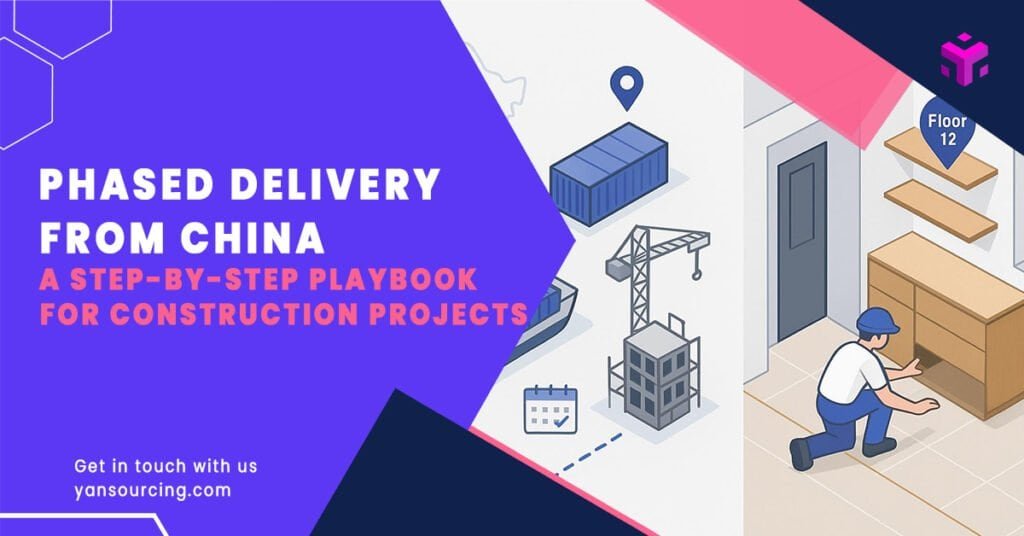
If you lead procurement or supply chain on a construction program, you live and die by milestone alignment.
The biggest risk in phased deliveries isn’t freight cost—it’s missed dates that stall trades, force rework, and blow your install windows.
This tutorial gives you a practical, repeatable way to run phased delivery management from China for construction, anchored on cabinetry and finish-material packages for hotels/apartments delivered by floor or zone.
We’ll convert your Material Need On Site (MNOS) dates into supplier gates, QA cadences, packaging specs, and logistics windows—so factory rhythm locks to site milestones.
Ready to pull the plan instead of chasing it?
Start from MNOS and work backward (the core rhythm)

Schedule reliability comes from making reliable promises and planning flow. Lean Construction’s Last Planner System and takt planning emphasize predictable cadence across zones and trades. See the Lean Construction Institute’s overview of takt time and reliable promises for grounding.
Translate each MNOS into a backward pass of gates:
set an ETA window at destination that gives you 3–4 weeks of float before MNOS (critical for finishes), determine ETD and Cargo Ready Date (CRD), reserve the pre-shipment inspection (PSI) window per floor set, lock production start and in-process checks, and hold mock-up approvals and design freeze as earlier gates.
Variability in ocean lanes (e.g., China→U.S. West ~12–18 days; East ~25–35) warrants that float; see Maersk’s market update for context.
Buffer math (working formula):
ETA variance = lane transit range + port/rail variability;
Float before MNOS = 3–4 weeks;
CRD = ETD minus export steps (3–7 days) and drayage;
Production start = CRD minus manufacturing lead (e.g., 8–12 weeks for custom cabinetry).
Think of MNOS as the drumbeat pulling the entire chain.
Define phases, IDs, and POs by floor/zone
Make the physical flow mirror your install sequence. Phase-code everything—PO lines, labels, packing lists—so site teams don’t waste time picking.
PhaseID schema (example):
| Field | Meaning | Example |
|---|---|---|
| Project | Site/program code | H1 |
| Floor | Install floor | F23 |
| Zone | Area/wing | ZA |
| Sequence | Install order | 02 |
CSV-like PO line snippet:
PO,PhaseID,SKU,Qty,PackType,Target_MNOS,Inspection_Window,CRD,Incoterm
45001234,H1-F23-ZA-02,BaseCabinet-BC600,24,Pallet-Kitted,2026-04-15,2026-03-20~2026-03-25,2026-03-27,FCA-Guangzhou
45001234,H1-F23-ZA-02,WallCabinet-WC400,18,Carton-Room,2026-04-15,2026-03-20~2026-03-25,2026-03-27,FCA-Guangzhou
Choose Incoterms to maximize visibility and realistic risk transfer.
FCA is often practical for containerized shipments; CFR/CIF shift risk at shipment while the seller pays freight (and insurance under CIF).
For a refresher, see our guide to Incoterms.
Mock-up-first and first article approvals
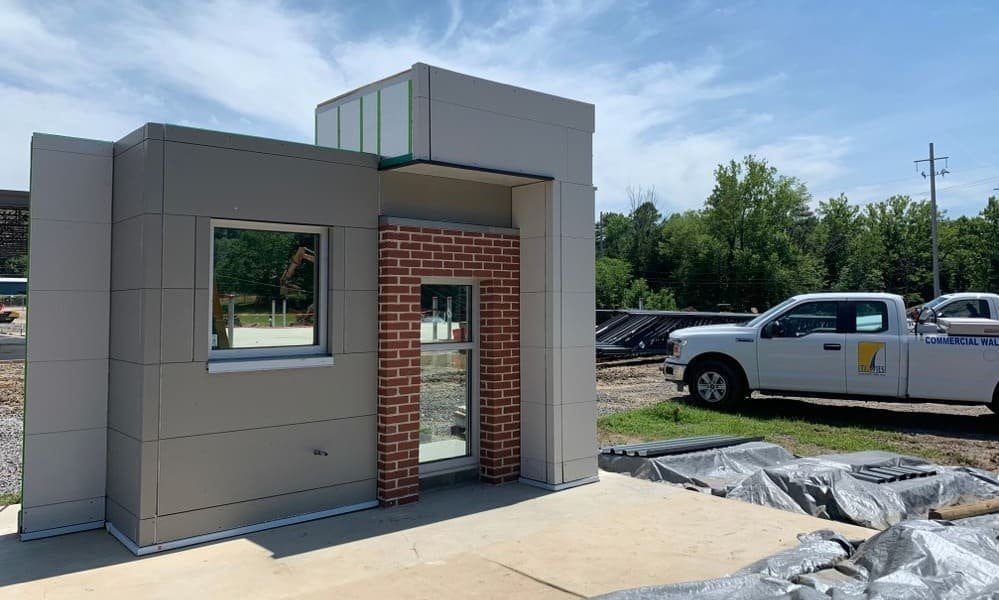
Run two mock-ups:
- a factory mock-up to verify materials, finishes, edge treatments, hardware models, tolerances, and packaging prototypes; and
- a near-site/on-site mock-up to confirm install fit, clearances, and sequence with trades.
Lock a golden sample and a spec pack (drawings, finish schedules, hardware lists) before mass release.
These approvals are gates—no production ramp until they’re signed.
Batch quality plan using AQL and PSI cadence
Quality drift between batches wrecks schedule certainty.
Use a multi-gate plan tied to each floor set:
- Pre-production approval (PPA) for materials and golden-sample conformity;
- in-process (DUPRO) checks with photo and dimension evidence; and
- pre-shipment inspections (PSI) per lot using AQL sampling.
Typical AQL targets for finish goods:
Critical at AQL 0.0 (operationally zero tolerance), Major at AQL 1.0–1.5 for high-visibility finishes, and Minor at AQL 2.5–4.0 depending on risk.
For how AQL sampling works under ISO 2859-1/ANSI Z1.4, see QIMA’s AQL overview and their pre-shipment inspection procedure. You can also reference our AQL sampling guide.
Formalize NCRs (nonconformances) with hold/release gates and corrective actions, and track supplier performance trends by lot.
Package and kit for jobsite reality

Design packaging backward from site constraints.
Elevators and hoists dictate maximum pallet size and weight; laydown areas are limited.
Use room-level kitting with clear labels that show PhaseID, room number, and install sequence.
Protect edges and corners, use moisture barriers and desiccants, and secure unitized loads with straps and corner posts.
For validation inspiration, ISTA 3A/3B distribution tests summarized by the International Safe Transit Association can guide acceptance criteria.
Lock logistics windows and buffers
Ocean lanes fluctuate.
Controls to apply:
float 3–4 weeks between ETA and MNOS for critical finishes;
lock CRD at least two weeks before ETD with bookings placed early on tight lanes;
and maintain a split-ship playbook—if a lot slips, release a partial by air or LCL for the first install zones.
For planning lane bands and buffer logic, see our guide to shipping time from China.
Phased delivery management from China for construction: customs and compliance you can’t ignore

Cabinetry/finishes bound for the U.S. touch multiple regimes.
TSCA Title VI (EPA) covers composite wood formaldehyde emissions with panel certification and finished-good labeling; importers must maintain records. Guidance is on EPA’s TSCA program pages.
The Lacey Act requires species, harvest country, quantities, and HTS codes declarations—see APHIS’s Lacey Act declaration page.
Classify HS codes early and confirm any AD/CVD exposure for wooden cabinets and vanities; for HS basics, see our HS code guide.
Set a compliance packet per lot (panel/TPC docs, labels, species data, ISPM 15 mark photos) and have your broker pre-alert entries 30 days before ETD.
On-site handover: receive, stage, and release to install
Reception and staging are part of schedule control.
- Verify labeling ties PhaseID to floor/room and install sequence;
- count cartons/pallets and photo-log any damage on receipt;
- stage unboxing to match install windows while protecting buffer stock with temporary coverings.
If a lot doesn’t match labels or arrives damaged, pause release, triage, and pull alternate stock for the immediate zones.
Practical workflow example (with disclosed agent)

Disclosure: Yansourcing is our product.
In practice, a sourcing agent like Yansourcing can be used to coordinate factory inspections per floor set (PPA/DUPRO/PSI with agreed AQLs), enforce packaging specs (corner guards, moisture barriers, room-level kitting), and align forwarders to lock delivery windows to MNOS.
The agent helps keep suppliers, QC, and logistics on the same cadence while giving you neutral status reporting.
Governance, dashboard, and escalation
Keep a live tracker and a disciplined cadence. A simple delivery dashboard should include PhaseID, lot, container/vessel, ETD/ETA, CRD, on-site delivery window, inspection status, and compliance docs received.
Run a weekly LPS/takt review to highlight gates in jeopardy and recovery plans.
Your escalation matrix should move issues from supplier to QC agent to forwarder to procurement lead, with time-boxed actions (for example, within 48 hours propose split-ship, air partial, or resequence install).
Troubleshooting quick fixes
Late production? Lock a revised CRD, book earliest space, split-ship critical rooms, and consider local purchase for specific fittings to protect install.
Seeing quality drift? Hold the lot, compare to the golden sample, trigger corrective actions, plan rework or replacements, and re-inspect before release.
Facing customs delays? Pre-alert with a full compliance packet and, if inspected, provide TSCA/Lacey documentation promptly; reroute next lots to maintain MNOS.
On-site damage? Photo-log immediately, quarantine affected kits, trigger supplier repair/replace per SLA, and apply temporary protection to similar items.
Closing: Next steps
Adapt the PhaseID schema, inspection cadence, and buffer math to your program.
If you need a neutral coordinator to keep factories, inspections, and forwarders on rhythm without you flying to China, a sourcing agent can help.
You can explore support with Yansourcing, or use the frameworks here to run phased delivery management from China for construction with confidence—pulling factory cadence to match your install windows.
